⚡ Quick Answer
An eco friendly kitchen apron is made from low-impact materials — such as organic cotton, hemp, or linen — and produced using responsible dyeing, ethical manufacturing, and durable construction. For restaurants and cafés, these aprons reduce environmental footprint while supporting a strong, values-driven brand image. Look for GOTS or OEKO-TEX certification to verify genuine sustainability claims.
Eco-Friendly Apron: Key Facts at a Glance
Before diving in, here are the most important facts about eco friendly kitchen aprons and the market they serve. This table gives you a fast snapshot of why sustainable aprons matter right now.
| Topic | Key Fact | Why It Matters |
|---|---|---|
| Organic cotton energy demand | 62% lower than conventional cotton | Proves the “low-impact” claim for fabric choice |
| Organic cotton global warming potential | 46% lower than conventional cotton | Strong sustainability claim for buyers |
| Hospitality travelers prioritizing sustainability | 83% say it matters | Shows strong demand for green café uniforms |
| Hospitality sector greenhouse gas share | About 40% of tourism-related GHG | Frames why sustainability matters in food service |
| Global apron market size | USD 2.5B (2023) → USD 4.1B (2032) | Growing market — opportunity for buyers and suppliers |
| Apron market growth rate | 5.5% CAGR | Demand is accelerating year over year |
Now, let’s look at each topic in detail. By the end of this guide, you will know exactly what to look for — and what to avoid — when sourcing a sustainable apron for restaurants, cafés, or your home kitchen.
What Makes a Kitchen Apron Eco-Friendly?
Not every apron that says “eco” actually is. So, it helps to understand the three main pillars that define a truly eco friendly kitchen apron: material, dyeing process, and durability.
1. Material
First and foremost, the fabric matters most. Conventional cotton uses large amounts of pesticides and synthetic fertilizers. In contrast, natural alternatives are much gentler on the planet.
The most common low impact kitchen textiles include:
- Organic cotton — soft, breathable, and widely certified
- Hemp — naturally pest-resistant and very durable
- Linen (flax) — low water usage and biodegradable
- Recycled fibers — diverts plastic waste from landfill and ocean
- Blended sustainable fabrics — combine performance with lower impact
2. Dyeing Process
Even a natural fabric can become harmful if dyed incorrectly. Low-impact dyes use less water, fewer toxic chemicals, and produce less runoff. Therefore, always ask your supplier about their dyeing methods before you buy in bulk.
3. Durability
Surprisingly, durability is also an eco factor. An apron that lasts three years is far greener than one replaced every six months. Reinforced stitching, quality hardware, and wash-resistant fabric all extend product life — and that directly reduces your environmental footprint.
💡 Pro Tip: When evaluating aprons, think of eco-friendliness as a whole lifecycle decision — not just what the fabric is made of, but how it was dyed, sewn, and how long it will last before needing replacement.
Why Organic Cotton Is the Best Apron Material
Among all eco-friendly fabrics, organic cotton stands out as the most trusted and versatile choice for aprons. Here’s why it leads the pack — especially for kitchens and food-service environments.
Lower energy demand vs. conventional cotton
Lower global warming potential
These figures come from a peer-reviewed life-cycle analysis. They show that switching to organic cotton is one of the most measurable steps a business can take toward truly low impact kitchen textiles.
What Makes Organic Cotton Different?
Certified organic cotton avoids several harmful inputs that conventional cotton relies on. Specifically, it eliminates:
- Toxic persistent pesticides
- Synthetic fertilizers
- Genetically modified organisms (GMOs)
- Hazardous chemical processing agents
As a result, organic cotton farming protects soil health, reduces water contamination, and supports safer working conditions for farmers. Furthermore, when paired with a certification like GOTS (Global Organic Textile Standard), you can trace those benefits all the way from the farm to the finished apron.
Organic Cotton vs. Conventional Cotton: A Quick Comparison
| Factor | Organic Cotton | Conventional Cotton |
|---|---|---|
| Pesticide use | ✅ None (certified) | ❌ Heavy use |
| Energy demand | ✅ 62% lower | ❌ High |
| Global warming potential | ✅ 46% lower | ❌ Higher emissions |
| Skin safety | ✅ Chemical-free | ⚠️ Residue risk |
| Certifiable? | ✅ GOTS, OEKO-TEX | ❌ Generally not |
For B2B buyers sourcing organic cotton aprons at volume, this certification layer is especially important. It gives you a paper trail you can share with your own customers — a growing expectation in modern hospitality and retail.
“Organic cotton is not just a fabric choice — it is a supply chain decision. When certified properly, it signals that every step of production has been held to a higher standard.”
Low-Impact Textiles: What Buyers Should Look For
Whether you are a restaurant owner ordering 200 aprons or a buyer sourcing private-label kitchen textiles, knowing what to look for keeps you from getting greenwashed. Here is a practical checklist for evaluating low impact kitchen textiles.
✅ The Low-Impact Textile Buyer’s Checklist
- Certified fiber: Look for GOTS, OEKO-TEX, or organic certification on the raw material
- Low-impact dyes: Ask specifically about dye type — azo-free and reactive low-impact dyes are preferred
- Water-conscious processing: Facilities using closed-loop water systems waste far less
- Chemical transparency: A reputable supplier will disclose what chemicals are used — and avoided
- Reinforced construction: Double-stitched seams, quality buckles, and bar-tack reinforcement extend product life
- Easy-care fabric: Machine-washable fabrics that hold up to repeated laundering reduce replacement frequency
- Traceability: Can the supplier tell you where the fiber was grown and processed?
🔍 Buyer’s Note: Durability is one of the most overlooked eco factors in textile sourcing. An apron replaced every 3 months generates 4x more waste than one replaced annually. Always ask about wash-cycle testing results before placing a bulk order.
Additionally, consider the packaging. Eco-friendly aprons shipped in single-use plastic bags are a contradiction. Look for suppliers who use recycled or minimal packaging as part of their overall commitment to low-impact production.
For more inspiration on sustainable textile sourcing, Textile World publishes excellent industry research on fiber innovation and sustainable manufacturing trends.
Certifications That Matter: GOTS and Beyond
Certifications cut through greenwashing. They give buyers — and end customers — a reliable, third-party way to verify sustainability claims. For eco friendly kitchen aprons and organic cotton aprons, these are the certifications worth knowing.
🌿 GOTS — Global Organic Textile Standard
GOTS is the gold standard for organic textiles worldwide. It covers not just the fiber, but the entire supply chain — including dyeing, sewing, labeling, and working conditions. So, when a supplier says their apron is “GOTS certified,” it means every step has been independently verified.
GOTS Certification Covers:
- Minimum 70% certified organic fiber content
- Prohibition of harmful chemicals and synthetic dyes
- Wastewater treatment requirements
- Fair labor and safe working conditions
- Annual on-site audits by accredited bodies
🏷️ OEKO-TEX Standard 100
OEKO-TEX tests the finished product for harmful substances. Even if the fiber isn’t organic, an OEKO-TEX 100 label means the final apron has been tested and is safe for skin contact. This is especially relevant for kitchen and food-service environments.
Other Certifications to Know
| Certification | What It Covers | Best For |
|---|---|---|
| GOTS | Full supply chain, organic fiber + processing | Organic cotton aprons |
| OEKO-TEX 100 | Harmful substance testing on finished product | All textile buyers |
| BSCI | Social compliance and fair labor auditing | B2B buyers with ethical sourcing policies |
| Fair Trade | Farmer and worker fair pay standards | Mission-driven brands |
| SGS / FDA | Safety and quality testing | Food-contact and kitchen use |
For example, Favor Houseware Co., Ltd. holds BSCI, OEKO-TEX 100, SGS, and FDA certifications — a strong package for buyers who need verified, safe, and responsibly made kitchen textiles.
How Sustainable Aprons Support Restaurants and Cafés
The restaurant and café industry is under growing pressure to clean up its environmental act. And the numbers show why. The hospitality sector contributes roughly 40% of tourism-related greenhouse gas emissions. As a result, both regulators and guests are asking businesses to do more.
Switching to a sustainable apron for restaurants is a practical first step. Here is how it fits into a broader green strategy.
Front-of-House Visibility
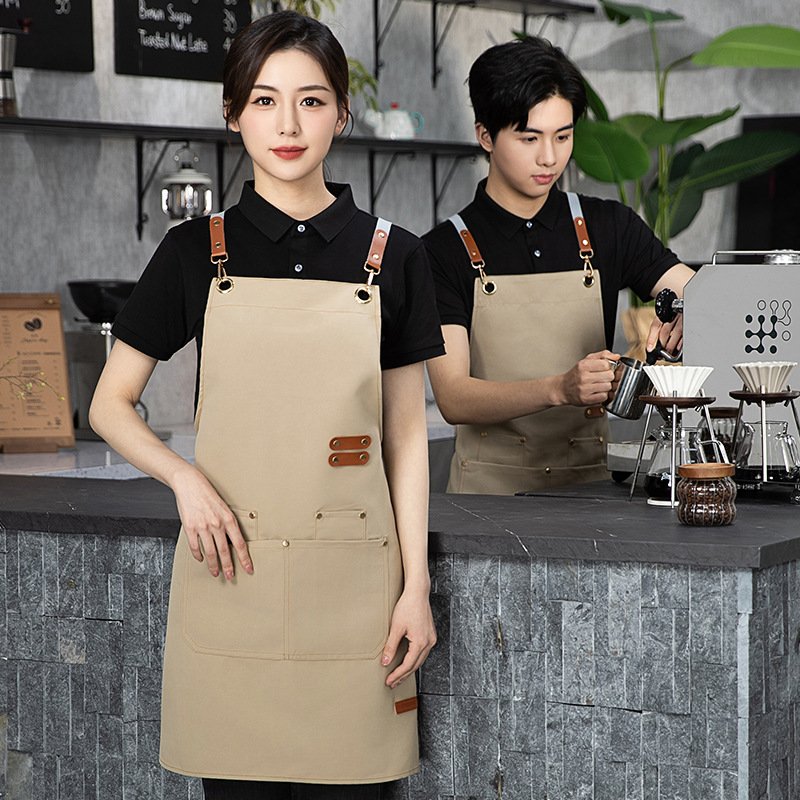
In café and restaurant settings, uniforms are visible to every customer. That means your apron choice becomes a silent brand statement. An organic cotton apron with a natural color palette or a “sustainably made” label tag communicates values before a single word is spoken.
Meeting Guest Expectations
Research shows that 83% of hospitality travelers actively prioritize sustainable choices when selecting where to eat and stay. Moreover, this figure continues to rise among younger demographics. Therefore, a green café uniform apron is no longer just a nice idea — it is a competitive advantage.
📊 Did You Know? 83% of travelers prioritize sustainability when choosing hospitality experiences. A green café uniform apron is one of the most visible ways to show guests that your business shares those values.
Part of a Larger Sustainability Program
Sustainable aprons fit naturally alongside other green initiatives, such as:
- Compostable packaging and straws
- Local and seasonal sourcing programs
- Energy-efficient kitchen equipment
- Zero-waste kitchen practices
In this context, the apron becomes part of a coherent story — not an isolated purchase. And when that story is authentic, it resonates with staff, guests, and media alike.

Why Green Café Uniform Aprons Matter for Brand Image
A green café uniform apron does more than cover clothing. It works as a visual trust signal. And in today’s market, that signal carries real commercial weight.
Sustainability as a Brand Differentiator
Think about two cafés side by side. One uses disposable paper aprons. The other uses certified organic cotton aprons with a branded label and natural earth tones. Even without reading a menu, most guests will associate the second café with quality, care, and integrity.
This matters because, increasingly, provenance and responsible sourcing are part of what customers are buying — not just the coffee or the meal.
Staff Pride and Retention
Interestingly, uniform quality also affects how staff feel about their workplace. A well-designed, comfortable, and sustainably made apron can boost team morale — especially among employees who hold personal environmental values.
Social Media and PR Value
Visually distinctive sustainable uniforms photograph well. As a result, they appear more often in customer Instagram posts, food media features, and press coverage. This organic visibility is free marketing — driven by a simple apron choice.
“In the café space, your uniform is your brand in motion. Every time a barista walks past a window, your values are on display. Make them count.”
For a deeper look at how branding and sustainability intersect in hospitality, the TXM China case studies offer useful real-world context on operations and brand alignment in manufacturing-led industries.
Best Apron Features for Busy Food-Service Teams
A sustainable apron must also be a practical apron. So, beyond the eco credentials, here are the features that matter most for daily use in busy restaurant and café kitchens.
Comfort for Long Shifts
- Cross-back straps: Distribute weight evenly and eliminate neck strain during long service periods
- Adjustable neck loops: Fit a wide range of body types with one apron size
- Lightweight breathable fabric: Essential in hot kitchen environments
Functionality for Daily Service
- Multiple pockets: Deep front pockets hold order pads, pens, and small tools
- Reinforced seams and bar-tack stitching: Prevents tearing at stress points
- Stain-resistant or wipeable finish: Some versions allow quick wipe-downs between services
Team Management Considerations
- Consistent sizing: Makes ordering, tracking, and replacing aprons far simpler
- Easy laundering: Machine-washable at 60°C to meet hygiene standards
- Color-fast dye: Maintains appearance through repeated washing
Feature Comparison: Apron Types for Food Service
| Feature | Bib Apron | Waist Apron | Cross-Back Apron |
|---|---|---|---|
| Coverage | Full front | Waist down | Full front |
| Comfort (long shifts) | ⭐⭐⭐ | ⭐⭐⭐⭐ | ⭐⭐⭐⭐⭐ |
| Branding surface | Large | Medium | Large |
| Best for | Kitchen staff | Front-of-house | All roles |
How to Choose a Sustainable Apron Supplier
For B2B buyers, choosing the right supplier is just as important as choosing the right fabric. So, here is what to evaluate — beyond price alone.
Key Questions to Ask Any Apron Supplier
- Where does the fiber come from? Can they trace it back to a certified farm?
- What dyes do they use? Are they low-impact, azo-free, or GOTS-compliant?
- Do they hold certifications? GOTS, OEKO-TEX, BSCI, or SGS are all positive signs
- What is the minimum order quantity (MOQ)? Low MOQ matters for small businesses and test orders
- Can they customize? Embroidery, screen printing, and woven labels turn aprons into uniforms
- What is their quality control process? Ask about inspection stages before shipment
- Do they offer samples? Any reputable supplier should allow sample evaluation before bulk commitment
Customization: Turning Aprons Into Uniforms
For restaurants and cafés, branding is non-negotiable. Fortunately, most quality manufacturers offer:
- Embroidery — clean, durable, and professional-looking
- Screen printing — great for bold logos and colors
- Digital printing — no MOQ for many suppliers; ideal for seasonal or small runs
- Woven labels — premium feel; communicates craftsmanship
🏭 Why Source From a Certified China Manufacturer?
China-based manufacturers like Favor Houseware Co., Ltd. combine advanced production technology, low MOQ, competitive pricing, and verified certifications (BSCI, OEKO-TEX, SGS, FDA). With 15 years of experience and facilities in Yiwu, Zhejiang Province, they offer full customization from fiber selection through to branded packaging — all with fast delivery options.
Also worth noting: when you source kitchen textiles from a manufacturer that also produces kitchen towels and oven mitts, you can consolidate orders, simplify logistics, and maintain visual brand consistency across your entire kitchen textile range.
For businesses interested in eco-friendly textiles beyond aprons, Favor Houseware also offers recycled beach towels and microfiber towels — showing their broader commitment to sustainable textile manufacturing.
Care and Durability Tips for Longer Apron Life
Even the most sustainable apron becomes wasteful if it wears out quickly. Therefore, proper care is an essential part of the eco-friendly story. Here is how to get the most life from your organic cotton apron or any sustainable kitchen textile.
Restaurant Apron Care: Step-by-Step
- Wash daily (or after each service): Food-service aprons should be laundered after every shift as a hygiene standard
- Use cold or warm water (40–60°C): Hot water degrades fibers faster — and costs more energy
- Choose eco laundry detergent: Phosphate-free, biodegradable detergents protect both the fabric and water systems
- Skip the tumble dryer when possible: Air drying extends fabric life and saves energy
- Treat stains promptly: Pre-treat food stains before washing to avoid aggressive scrubbing that weakens fibers
- Store properly: Hang aprons flat or on hooks — avoid crumpling or folding under heavy items
- Inspect regularly: Check seams, straps, and hardware monthly; minor repairs prevent full replacements
⚠️ Avoid: Bleach-based cleaners on organic cotton aprons. They break down natural fibers rapidly and eliminate any OEKO-TEX safety benefits by introducing harsh chemical residues.
How Long Should a Quality Apron Last?
A well-made, properly cared-for organic cotton kitchen apron should last 1–3 years in daily restaurant use. For comparison, a cheap synthetic apron may need replacing every 3–6 months — creating 4–6 times more textile waste over the same period.
This is one of the most compelling arguments for investing in quality sustainable aprons upfront: the total cost of ownership is often lower, and the environmental footprint per year of use is significantly reduced.
FAQ: Eco-Friendly Kitchen Aprons
Here are the most commonly asked questions about eco friendly kitchen aprons, with clear and helpful answers.
Conclusion: Make Your Apron Choice Count
Choosing an eco friendly kitchen apron is not just a purchasing decision. It is a statement about what your business values — and increasingly, it is what your customers expect.
To summarize, the most important things to remember are:
- Organic cotton delivers measurable environmental benefits — 62% less energy, 46% lower global warming potential
- Certifications like GOTS and OEKO-TEX separate genuine sustainability from greenwashing
- Durability is an eco factor — a longer-lasting apron creates less waste
- 83% of hospitality guests prioritize sustainability — your uniform is part of your brand promise
- The right supplier combines certified materials, customization, low MOQ, and quality control
Whether you are outfitting a small café team or sourcing 500 aprons for a restaurant group, the right partner makes all the difference. Additionally, consolidating your sustainable kitchen textiles — aprons, kitchen towels, and oven mitts — with one certified manufacturer simplifies your supply chain and strengthens your sustainability story.
Ready to Source Sustainable Kitchen Aprons?
Work With a Certified Manufacturer You Can Trust
Favor Houseware Co., Ltd. offers custom eco friendly kitchen aprons with BSCI, OEKO-TEX, SGS, and FDA certifications. Low MOQ from 100 pieces. Free samples available. Fast delivery from Yiwu, China.
Have questions about bulk ordering, custom branding, or certifications? Contact our team — we respond within 24 hours.
Views: 10