Beach Towel Material Guide: GSM, Fabric Types & Best Specs for Custom Beach Towels
Picking the wrong material or GSM for your beach towels is a costly mistake. It leads to towels that are too heavy, too thin, or impossible to print on. So, in this guide, we break down everything in simple terms. Whether you are a retail buyer, resort owner, or brand looking for custom beach towels, this article will help you choose the right specs, fast.
⚡ Quick Reference: Beach Towel GSM & Material at a Glance
Not sure where to start? This table gives you the most important information right away. Find your use case, then read the full guide below for details.
| Use Case | Best Material | Ideal GSM | Key Benefit | Best Print Method |
|---|---|---|---|---|
| Travel / Gym / Giveaway | Microfiber (poly / rPET) | 200–280 GSM | Lightweight, packs small, dries fast | Full-color sublimation |
| Standard Retail Beach Towel | 100% Cotton Terry | 330–420 GSM | Soft, absorbent, great for printing | Reactive printing, jacquard |
| Premium Resort / Hotel | High-quality Cotton Terry | 380–450 GSM | Plush feel, logo-ready, durable | Jacquard, embroidery, border branding |
| Eco / Sustainable Brand | rPET Microfiber or Bamboo-Cotton | 280–380 GSM | Eco-friendly, soft, good print quality | Sublimation (rPET), reactive (bamboo) |
| Custom Logo / Branded Towel | Cotton Velour (sheared) | 320–450 GSM | Smooth print face, soft terry back | Reactive printing, woven labels |
Now, let us go deeper into each topic. First, let’s start with the most common question buyers ask.
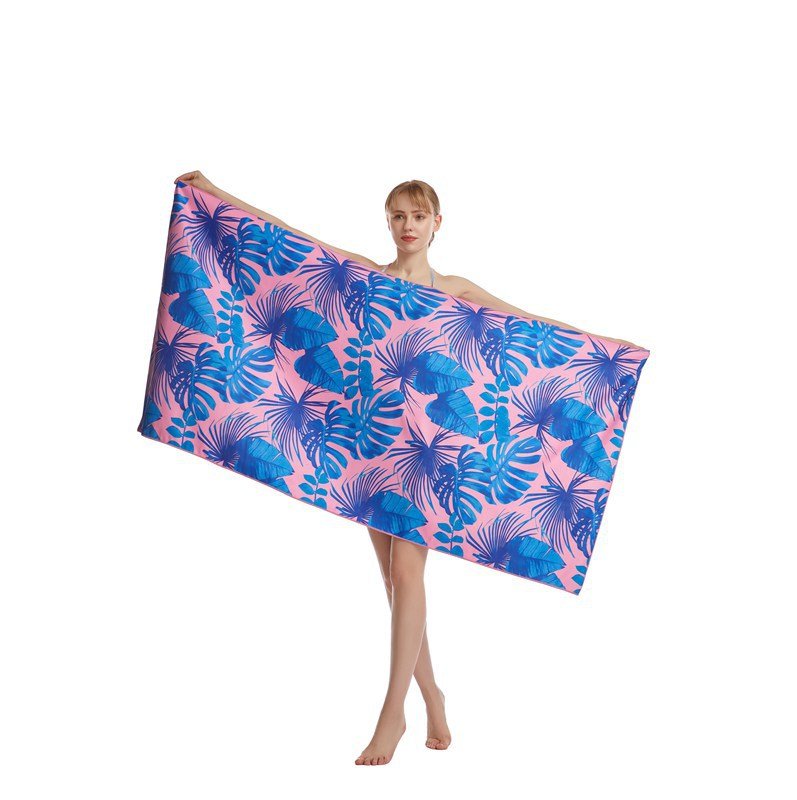
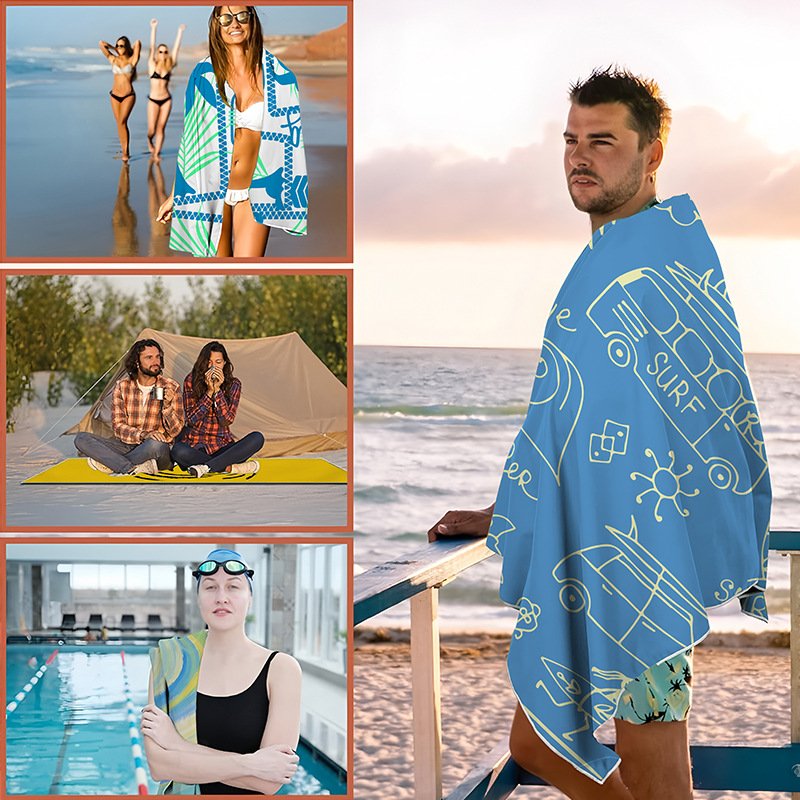
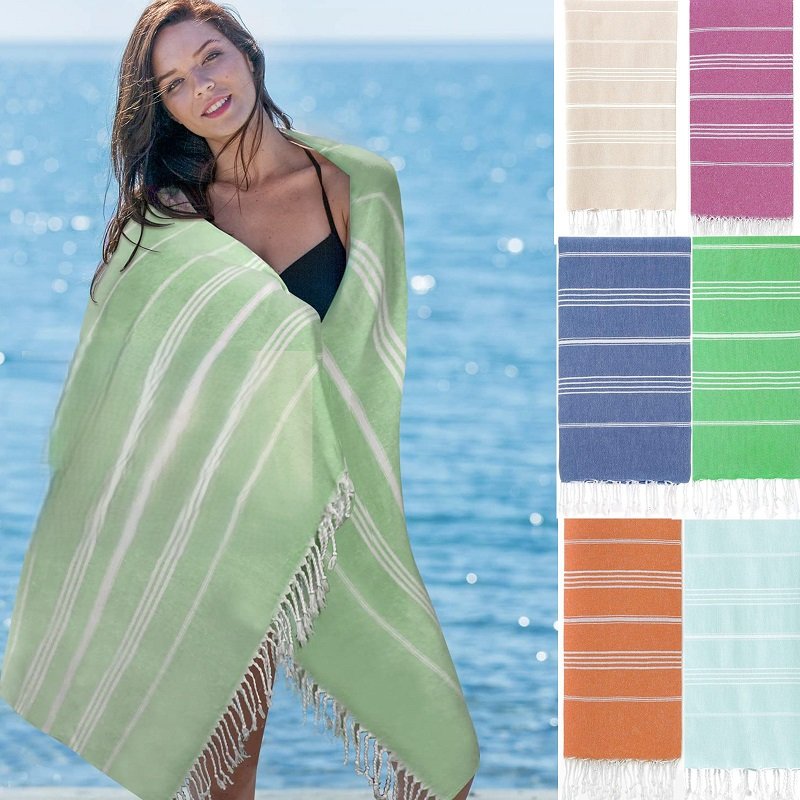
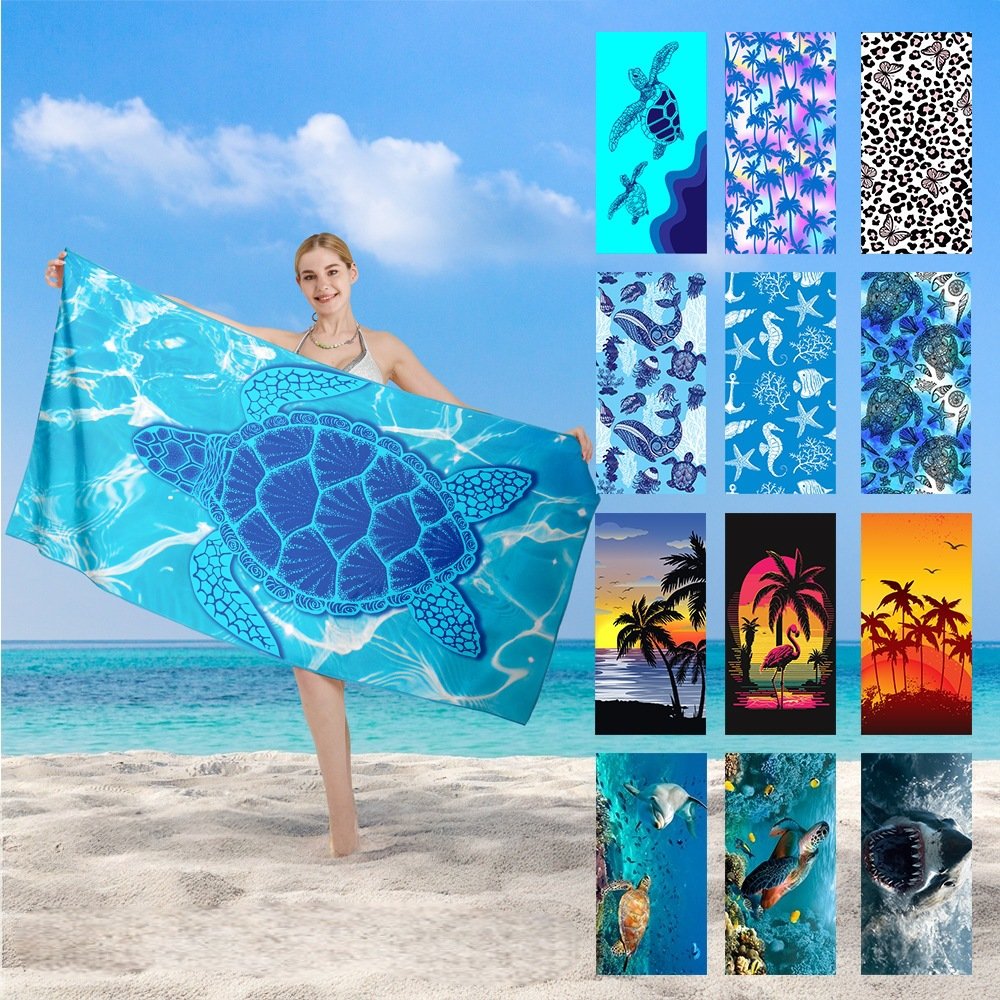
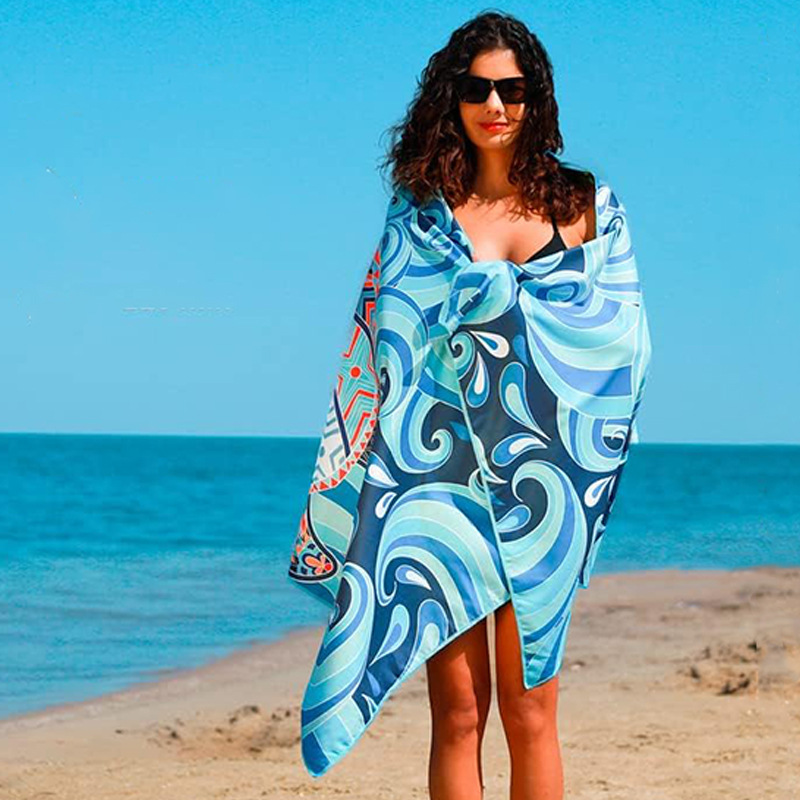
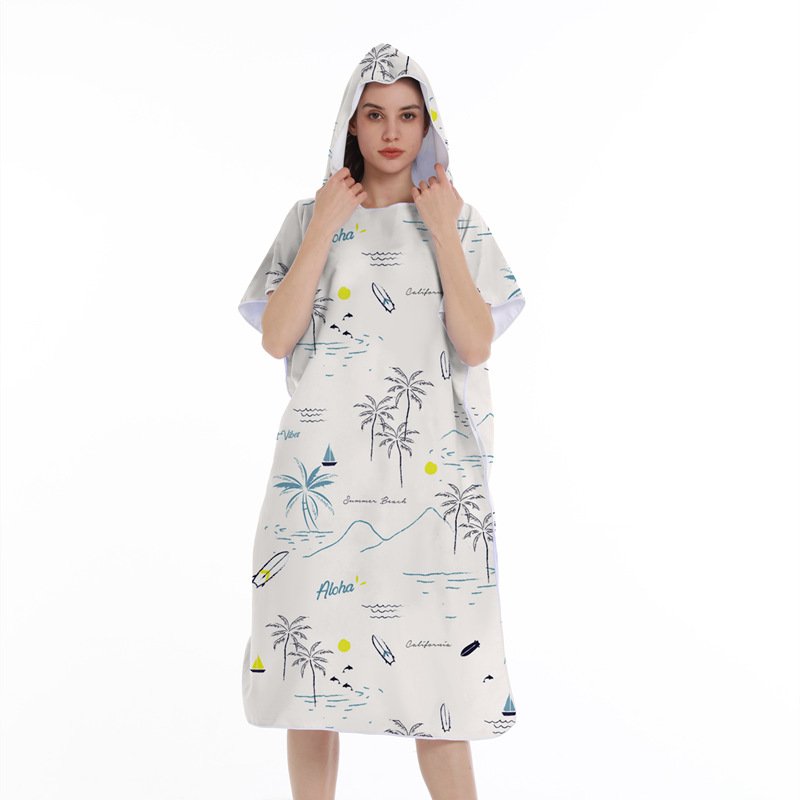
What Is Beach Towel GSM and Why It Matters
Think of it like this: GSM is the “weight rating” of a towel. Furthermore, it tells you a lot about how the towel will perform at the beach. For example, a towel with a high GSM will feel plush and absorb a lot of water. However, it will also take longer to dry.
Most towels in general fall between 300 and 900 GSM. Additionally, each range is designed for a different purpose. Here is a clear breakdown to help you understand each tier:
| Towel Type / Use | Typical GSM Range | Key Characteristics |
|---|---|---|
| Travel / Gym Towels | 300–400 GSM | Lightweight, thinner fabric, dries quickly, easy to pack into a bag. |
| Standard Beach Towels | 300–400 GSM | Ideal for beach use — enough absorbency but still quick-drying and portable. |
| Bath / Multi-Purpose Towels | 400–600 GSM | Medium to heavy feel, softer and more absorbent, but slower to dry. |
| Luxury Spa / Hotel Towels | 600–900 GSM | Very plush and heavy, ultra-absorbent, longest drying time of all. |
So, as you can see, beach towel GSM is one of the most important specs to get right. In fact, understanding it helps buyers make smarter decisions. Moreover, it saves money by avoiding orders that don’t meet expectations.
- Most towels are between 300–900 GSM overall, but many beach towels are specifically designed around 300–400 GSM for faster drying.
- Microfiber beach towels can absorb up to about seven times their own weight in water — while still drying faster than cotton.
What Is the Ideal GSM for a Beach Towel?
Many industry buying guides recommend 300–400 GSM as the sweet spot for beach towels. The reason is simple. First, the beach is not a bathroom. Therefore, you need a towel you can carry, lay on, and bring home — often wet. As a result, lighter GSM wins at the beach.
However, there is one important exception. Hotels, resorts, and beach clubs often prefer a slightly heavier option. Specifically, 380–450 GSM beach towels are marketed as “premium beach towels.” They feel thicker and more luxurious. Guests notice the difference. Nevertheless, they do take longer to dry on the lounger.
“Bath towels usually aim for 400–600 GSM because they stay in the bathroom. Beach towels aim lower — around 300–400 GSM — so they dry fast and are easy to carry when wet.”
In short, here is how to think about it: lower GSM = more portable and practical. Meanwhile, higher GSM = more luxurious and plush. The best choice depends on who will use the towel and where.
How GSM Affects Absorbency, Drying Time and Packing Volume
Understanding how GSM affects daily performance is key for any buyer. Let’s break it down clearly. After all, these three factors — absorbency, drying time, and packing volume — directly affect how customers experience your product.
- 🧺 Higher GSM = more absorbency. A denser towel has more fabric per square meter. Therefore, it soaks up more water per use. This is why luxury spa towels feel so satisfying after a shower.
- ☀️ Lower GSM = faster drying. Less dense fabric means air passes through more easily. As a result, the towel dries much faster in the sun or wind at the beach.
- 🎒 Lower GSM = easier to pack. Lighter towels take up less space. Furthermore, they weigh less in a beach bag or suitcase. This matters a lot for travel products and promotional giveaways.
- 📦 Lower GSM = lower shipping costs. For bulk wholesale orders, lighter GSM means more pieces per carton. Consequently, shipping costs per unit go down — a big deal for importers.
Here is a simple tier guide to help you decide:
| GSM Tier | Best For | Trade-Off |
|---|---|---|
| 300–350 GSM | Travel, kids’ towels, event giveaways, compact packing | Less plush feel, lower perceived quality |
| 350–400 GSM | Good “standard” beach towel for retailers and resorts | Balanced — no major trade-offs at this range |
| 400–450 GSM | Premium beach experience, thicker feel, hotel amenity | Slower drying, higher cost, heavier to ship |
- If shipping cost and carton volume are critical to your order, always choose a lighter GSM. It reduces freight and storage cost significantly on large OEM orders.
- If you are sourcing for a resort or hotel, the 380–450 GSM range gives guests that “premium” feeling they associate with high-end service.
Beach Towel Material Guide: Cotton vs Microfiber vs Blends
Now that you understand GSM, let’s talk about material. In fact, the fabric is just as important as the weight. Your choice of material determines softness, absorbency, print quality, durability, and even your brand’s eco credentials.
| Material | Typical GSM for Beach Use | Absorbency | Drying Speed | Hand Feel / Comfort |
|---|---|---|---|---|
| 100% Cotton Terry | 300–450 GSM | High, especially at 350–450 GSM | Medium, slower than microfiber | Very soft, classic familiar towel feel |
| Cotton Velour (Sheared) | 320–450 GSM | Good — print face stays smooth, terry back absorbs well | Medium | Smooth printed face, soft looped back |
| Microfiber (Poly / rPET) | 200–400 GSM | Can absorb up to ~7× its own weight | Fast to very fast drying | Thinner, less plush — some find it less cozy |
| Bamboo / Bamboo-Cotton Blend | 300–450 GSM | Very absorbent, naturally moisture-wicking | Medium | Very soft and smooth — great for sensitive skin |
1. 100% Cotton Terry — The Classic Beach Towel Material
Cotton is, without question, the most popular beach towel material in the world. Moreover, it has been the go-to choice for decades. Cotton is naturally soft, skin-friendly, and absorbent. Additionally, it gets softer with every wash — which customers absolutely love.
Furthermore, cotton terry is excellent for printing. Whether you need reactive prints or jacquard designs, cotton holds color beautifully. So, for most retail and resort buyers, cotton remains the first choice.
👉 Best for: Retail collections, hotel amenities, branded resort towels, long-lasting products.
Explore our full range of custom cotton beach towels manufactured in China.
2. Cotton Velour — The Best Surface for Custom Printing
Velour is a type of cotton fabric where one side is sheared smooth and the other side keeps the looped terry texture. As a result, you get the best of both worlds. The smooth face is perfect for vibrant, sharp custom prints. Meanwhile, the terry back absorbs water effectively.
Therefore, if your brand needs a beach towel with a bold, full-color design, cotton velour is the top pick. In fact, most reactive-printed custom beach towels use velour for exactly this reason.
👉 Best for: Custom logo beach towels, promotional products, branded resort merchandise.
3. Microfiber — Lightweight, Fast-Drying, and Travel-Ready
Microfiber towels are made from ultra-fine synthetic fibers. Usually, they are a blend of polyester and polyamide. These tiny fibers create a towel that is incredibly lightweight but surprisingly absorbent. In fact, microfiber can absorb up to seven times its own weight in water.
Moreover, microfiber dries two to three times faster than cotton. As a result, it is the perfect choice for travel, sports, and outdoor events. Additionally, microfiber works extremely well for full-color edge-to-edge sublimation printing — ideal for bright, photographic designs.
However, microfiber does feel less plush than cotton. So, for luxury hotel applications, cotton is still the preferred choice. Explore our microfiber beach towel collection for more details.
👉 Best for: Travel towels, sports brands, surf shops, compact promotional giveaways.
4. Bamboo & Bamboo-Cotton Blends — The Eco-Friendly Option
Bamboo-cotton blends are growing fast in popularity. Specifically, eco-conscious brands and sustainable retail lines love them. Bamboo fiber is naturally soft, hypoallergenic, and moisture-wicking. Furthermore, bamboo grows without pesticides and regenerates quickly — making it a responsible material choice.
Additionally, our recycled rPET beach towels are made from post-consumer plastic bottles. Consequently, they help reduce plastic waste while still delivering excellent performance.
👉 Best for: Eco-positioned brands, sustainable retail, environmentally-conscious promotional products.
Best Material and GSM for Custom Logo Beach Towels
So, what is the best material for custom beach towels? The answer depends on your specific use case, budget, and print method. Fortunately, the table below makes it very easy to decide.
| Use Case / Buyer Type | Recommended Material | Recommended GSM | Recommended Decoration Method |
|---|---|---|---|
| Mass Promos / Events | Microfiber (poly or rPET) | 200–280 GSM | Full-color sublimation, all-over logo printing |
| Retail Brand Beach Collection | Cotton Terry / Velour | 330–420 GSM | Reactive printing, yarn-dyed jacquard, woven labels |
| Resorts, Hotels, Beach Clubs | High-quality Cotton Terry | 380–450 GSM | Jacquard logo, embroidery, border branding |
| Eco-Positioned Brands | rPET Microfiber or Bamboo Mix | 280–380 GSM | Sublimation (rPET), reactive print (bamboo blends) |
We manufacture custom beach towels across all of the above specs — every GSM range, every material type, and every print method listed in this table. Moreover, with 15 years of experience, our team can help you select the exact combination that fits your product goals, budget, and shipping requirements. Our MOQ starts at just 100 pieces, and we offer free samples (you only pay freight). We hold BSCI, OEKO-TEX 100, SGS, and FDA certifications, so quality and safety are never a concern. Contact us to request a quote →
How to Choose the Right Beach Towel GSM for Your Brand
Choosing the right beach towel GSM does not have to be complicated. In fact, you can follow this simple three-step process. Additionally, it works for both small businesses and large OEM buyers.
Step 1: Think About Your Customer’s Main Priority
- If your customers care most about lightweight travel and quick drying, then choose a lower GSM (around 300–350). Furthermore, consider microfiber for even faster drying and easier packing.
- If your customers care most about luxury feel and thickness, then choose a higher GSM (around 380–450). Additionally, opt for high-quality cotton terry for the best hand feel.
- If your customers want a balance of both, then the 350–400 GSM range is your safest choice. It works well for most retail and resort applications.
Step 2: Consider Your Shipping and Storage Costs
This is especially important for international buyers. Specifically, lighter GSM means more units per carton. As a result, you pay less freight per piece. Moreover, lighter towels store more efficiently in a warehouse. So, if you are ordering 10,000+ pieces for a promotional campaign, the GSM choice directly affects your landed cost.
Step 3: Match GSM to Your Print or Decoration Method
Finally, your print method should guide your GSM choice. Here is a quick reference:
- Full-color sublimation printing → works best on low-GSM microfiber (200–280 GSM). The smooth surface produces sharp, photographic results.
- Reactive printing and jacquard designs → work best on medium-GSM cotton terry or velour (320–420 GSM). The fabric holds pigment beautifully.
- Embroidery and woven labels → work best on higher-GSM cotton terry (380–450 GSM). The dense base fabric holds stitching firmly without puckering.
Also, consider exploring related products like our Turkish hammam towels — a naturally lightweight and fast-drying option — or our surf changing robes for beach and water sports brands.
“The best beach towel GSM for your brand is the one that matches what your customers actually need — not just the heaviest or the cheapest option available.”
Frequently Asked Questions About Beach Towel GSM and Materials
❓ What is a good GSM for a beach towel?
A good GSM for a beach towel is usually between 300 and 400 GSM. This range keeps the towel light and easy to carry. It also allows the towel to dry faster after swimming. Moreover, it still absorbs enough water to dry you off comfortably. Heavier options around 380–450 GSM can be marketed as premium beach towels with a thicker, more luxurious feel. However, they will dry more slowly in the sun.
❓ Does higher GSM mean a better beach towel?
Higher GSM usually means the towel is denser, more absorbent, and softer. As a result, many people associate higher GSM with better quality. However, for beach use, “better” also means quick drying and easy to carry. Therefore, an extremely high GSM can actually be too heavy and slow-drying for travel and promotions. Brands often choose a mid-range GSM to balance comfort, function, and shipping cost.
❓ What material is best for beach towels?
Cotton is the most popular material for beach towels because it is soft, absorbent, and gentle on the skin. Furthermore, it holds up well to repeated washing. Microfiber is best when fast drying, compact packing, and lightweight shipping are top priorities — such as for travel, sports, or high-volume giveaways. Meanwhile, blended and eco materials like bamboo-cotton or recycled polyester microfiber are ideal for brands that want both performance and sustainability messaging.
❓ Is microfiber or cotton better for a beach towel?
Microfiber beach towels dry much faster and can absorb a lot of water relative to their weight. So, they are great for travel, sports, and frequent washing. On the other hand, cotton beach towels feel softer and more natural on the skin. Consequently, they are often preferred for resorts, hotels, and traditional retail products — even though they take longer to dry. In fact, many brands offer both: microfiber for compact, full-print towels and cotton for plush, premium options.
❓ How do I choose GSM for custom logo beach towels?
Start by thinking about how and where the towel will be used. For mass giveaways or travel, choose around 300–350 GSM to keep each piece light and affordable. For retail or resort use, 330–420 GSM gives a more premium feeling towel without becoming too heavy for beach use. Then, match the material and GSM to your print method: lower-GSM microfiber is ideal for full-color sublimation, while medium-GSM cotton terry or velour works well for reactive printing, jacquard, and embroidery.
❓ What size and GSM should a beach towel be?
A typical beach towel is around 70×140 cm or larger. Additionally, combining this size with 300–400 GSM keeps the towel easy to carry and quick-drying. For hotel and resort buyers who want extra-large towels, we recommend a slightly higher GSM in the same range. This ensures enough coverage and comfort without making the towel too heavy when wet. Contact us to discuss custom sizing options.
❓ Are thicker beach towels always better?
Not necessarily. Thicker, higher-GSM towels feel more luxurious and absorb more water. However, they are also heavier, bulkier, and take longer to dry in the sun. Therefore, for most beach or pool situations, a mid-weight towel (350–420 GSM) gives a better balance between comfort and practicality than an ultra-thick towel. Ultra-thick towels shine in spa or hotel settings — not so much at a public beach.
❓ Can I use bath towel GSM for beach towels?
Bath towel GSM guidelines — typically 400–600 GSM for everyday use — can be a starting point. However, beach towels usually aim lower to dry faster and pack more easily. Furthermore, many industry buying guides specifically recommend 300–400 GSM as ideal for beach towels instead of the heavier ranges used for luxury bath towels. So, if a supplier quotes you 600 GSM for a beach towel, consider whether that weight is really appropriate for outdoor beach use.
Further Reading & Industry Resources
Want to learn more about towel standards, textile testing, and sustainable sourcing? Here are some trusted external resources worth exploring:
- 🌐 OEKO-TEX Standard 100 — The global certification that tests for harmful substances in textiles. Favor Houseware is certified, so every towel we produce meets this standard.
- 🌐 BSCI (Business Social Compliance Initiative) — A leading audit program ensuring ethical and responsible factory working conditions.
- 🌐 Textile Exchange — Recycled Claim Standard — The standard used for verifying recycled content in products like our rPET microfiber beach towels.
- 🌐 Intertek Textile Testing — A trusted third-party testing lab used globally to verify towel quality, GSM, colorfastness, and shrinkage.
Conclusion: Choosing the Right Beach Towel Material & GSM
By now, you have a clear picture of how beach towel GSM and material work together. To summarize: 300–400 GSM is the ideal range for most beach towels. Cotton is the top choice for softness and print quality. Microfiber wins for travel and full-color designs. And eco materials like rPET and bamboo-cotton are the right call for sustainable brands.
Moreover, the best material for custom beach towels is not one-size-fits-all. Instead, it comes down to your customer’s priorities — whether that is luxury feel, fast drying, compact packing, vivid branding, or eco credentials.
Ultimately, getting the specs right from the start saves you time, money, and headaches. Therefore, it always pays to work with an experienced manufacturer who can guide your decision every step of the way.
Ready to Order Custom Beach Towels?
Favor Houseware Co., Ltd. has 15 years of experience manufacturing custom beach towels for brands, resorts, retailers, and promotional companies worldwide. We produce every material type and GSM range covered in this guide — with MOQ from just 100 pieces, free samples, and OEKO-TEX / BSCI certified quality.
Get a Free Quote Today View Our ProductsViews: 3