⚡ Key Takeaways at a Glance
| Topic | Fast Fact |
|---|---|
| 🌍 Europe market size (2022) | USD 132.27 million |
| 📈 Projected market size (2028) | USD 189.04 million (6.1% CAGR) |
| ♻️ CO₂ saving — rPET vs virgin polyester | ~60% less emissions per kg of fibre |
| 🏖️ Microfiber vs cotton towel footprint | Microfiber has ~76% lower impact than cotton |
| 🌱 Recycled microfiber + renewable energy saving | Additional 21% reduction vs standard microfiber |
| 🏅 Top certifications for Europe | GOTS, GRS, OEKO-TEX® 100, BSCI |
| 🧵 Most popular eco materials | rPET, Organic Cotton, Cotton–rPET Blends |
| 📦 Low MOQ from China manufacturer | Starting from 100 pieces — Favor Houseware |
So, you’re looking for eco friendly beach towels in Europe. First, know this: the European market is changing fast. Furthermore, new EU rules are making sustainability a legal requirement, not just a nice-to-have. Therefore, whether you’re a hotel, a beach brand, or a corporate buyer, understanding your options now will save you time and money later.
In this guide, we’ll cover everything you need to know. Specifically, we’ll look at the best eco materials, real carbon footprint numbers, key certifications, and practical tips for working with a manufacturer. Let’s dive in.
What Is an Eco Friendly Beach Towel? (Quick Answer)
An eco friendly beach towel uses lower-impact materials — such as recycled polyester (rPET) or organic cotton — combined with cleaner production methods and longer product life. As a result, it uses less water, less energy, and fewer chemicals than a standard towel. By 2030, the EU requires textiles sold in Europe to be durable, recyclable, largely made of recycled fibres, and free from hazardous substances.
Three Ways Eco Towels Reduce Environmental Impact
Eco friendly beach towels tackle pollution in three clear ways. Here’s how each one works:
- Lower-impact materials: These include recycled polyester (rPET), organic cotton, bamboo blends, and recycled cotton. All of these create far less pollution than regular fibres.
- Cleaner production: Eco factories use less water, less energy, and safer chemicals. Additionally, they treat wastewater properly before releasing it.
- Longer product life: A durable towel that lasts 5+ years replaces several cheap towels. Therefore, it creates less total waste over time.
What the EU 2030 Textiles Strategy Means for Buyers
The EU’s Strategy for Sustainable and Circular Textiles is a big deal. Essentially, it means that by 2030, every textile sold in Europe must meet strict new rules. As a result, buyers across Europe are already preparing. Here’s what the strategy requires:
- ✅ Products must be long-lasting and durable
- ✅ They must be recyclable at end of life
- ✅ They must use largely recycled fibres
- ✅ They must be free of hazardous substances
- ✅ They must be made under fair and safe working conditions
Market Snapshot: Demand for Sustainable Beach Towels in Europe
First, let’s look at the numbers. The European beach towel market is growing steadily. Moreover, the shift toward eco friendly and recycled options is a key part of that growth.
| Metric | Data Point | Note |
|---|---|---|
| Market size 2022 | USD 132.27 million | Baseline market value |
| Forecast market size 2028 | USD 189.04 million | Projected growth |
| CAGR 2022–2028 | 6.1% | Steady, consistent growth |
| Key tourism-driven countries | Spain, Italy, Greece, France, Germany, UK | Highest beach towel demand |
| Top trend noted in reports | Growing preference for eco friendly & recycled microfiber towels | Strong angle for brand positioning |
| Consumer sustainability behaviour | ~38% of shoppers in Europe’s top 5 markets consider environmental impact | Buying decision factor |
| Sustainable fashion purchases (2022) | ~46.5% of European consumers bought sustainable fashion | Confirms eco buyer demand |
“In France, 44.9% of shoppers bought eco-responsible clothing in 2022. Furthermore, more consumers now say materials are the most important eco-responsibility criterion.” — 2023 Consumer Study
In other words, European consumers are voting with their wallets. Therefore, brands that offer sustainable branded beach towels are not just being responsible — they’re being smart about business, too.
Key Materials for Sustainable Branded Beach Towels (rPET, Organic Cotton, Blends)
Next, let’s talk about materials. Not all eco materials are the same. However, three main options stand out for sustainable branded beach towels in the European market.
rPET — Recycled Polyester from Plastic Bottles
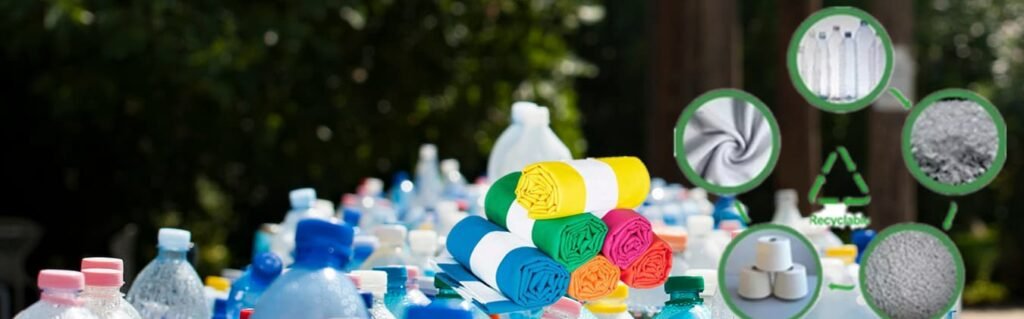
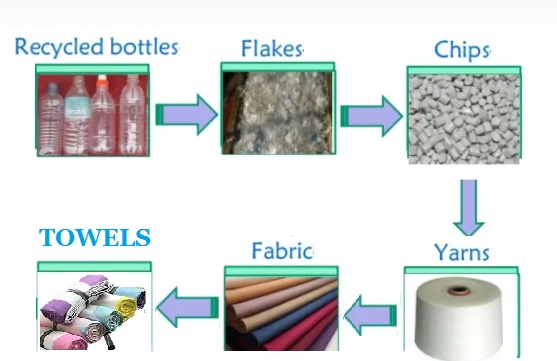
rPET stands for recycled polyethylene terephthalate. In simple terms, it’s plastic bottles turned into soft, functional fabric. Here’s why it’s so popular:
- ♻️ One standard beach towel can use 8–12 recycled plastic bottles
- 💧 Uses significantly less water than growing cotton
- ⚡ Produces ~60% fewer CO₂ emissions than virgin polyester
- 🏅 Certifiable under the Global Recycled Standard (GRS)
Favor Houseware’s recycled beach towels are made with GRS-certified rPET. Furthermore, they come with full documentation for European buyers who need proof of recycled content.
Organic Cotton — GOTS Certified
Organic cotton is grown without synthetic pesticides or fertilisers. As a result, it’s much safer for farmers and for the planet. Key facts:
- 💧 Uses up to 91% less water than conventional cotton (Textile Exchange)
- ⚡ Uses up to 62% less energy than conventional cotton
- 🌿 Free from harmful chemical residues
- 🏅 Certifiable under GOTS (Global Organic Textile Standard)
Organic cotton towels, therefore, directly support Scope 3 emissions reductions. This is critical for brands operating under science-based emissions targets (SBTi).
Cotton–rPET Blends
Blended towels combine the best of both worlds. Specifically, they mix the softness and absorbency of cotton with the durability and quick-drying benefits of recycled polyester. As a result, they’re a flexible and popular choice for resort and hotel buyers.
| Material | Main Benefit | Certification | Best For |
|---|---|---|---|
| rPET Microfiber | Lowest carbon footprint; quick-dry | GRS | Travel, sports, branded merch |
| Organic Cotton | Soft, absorbent, chemical-free | GOTS | Luxury hotels, premium retail |
| Cotton–rPET Blend | Balanced softness + durability | GRS + GOTS | Resort, hospitality, gifting |
| Recycled Cotton | Diverts textile waste; low water use | GRS / RCS | Promotional, corporate gifts |
| Bamboo Blend | Naturally antibacterial; ultra-soft | OEKO-TEX® | Wellness, spa, boutique |
Carbon Footprint: Conventional Cotton vs Recycled Microfiber Beach Towels
Here’s where the data gets really interesting. Most people don’t realise how big the difference is. Specifically, a recycled microfiber beach towel can have a dramatically lower carbon footprint than a standard cotton towel. Let’s look at the numbers.
| Towel Type (50×95 cm) | Carbon Footprint (kg CO₂e) | Reduction vs Cotton |
|---|---|---|
| 🌾 Conventional cotton towel | ~11.25 kg CO₂e (estimated) | Baseline |
| 🧴 Standard microfiber towel | 2.70 kg CO₂e | ~76% lower than cotton |
| ♻️ Recycled microfiber + renewable energy | ~2.13 kg CO₂e | ~81% lower than cotton; 21% less than standard microfiber |
Additionally, the footprint scales with towel size and weight. Therefore, for a larger beach towel (e.g. 80×160 cm), the savings per unit become even more significant. You can contact Favor Houseware to request a detailed Life Cycle Assessment (LCA) for specific towel sizes.
How Many kg of CO₂ Can a Recycled Beach Towel Save?
Furthermore, a corporate case study shows that switching 20,000 tonnes of polyester clothing to recycled PET can avoid over 21,000 tonnes of CO₂eq. Therefore, the business case for switching to recycled beach towels is clear — both for the planet and for your brand’s ESG reports.
Why European Brands Switch to Sustainable Branded Towels
Beyond the environment, there are strong business reasons to switch. Here’s what’s driving European brands to choose sustainable branded beach towels right now.
Consumer Demand Is Real and Measurable
- 📊 Around 38% of consumers in Europe’s five largest markets consider a brand’s social and environmental impact when shopping
- 🛍️ Roughly 46.5% of European consumers bought sustainable fashion items in 2022
- 🇫🇷 In France specifically, 44.9% of respondents purchased eco-responsible clothing in 2022
- 🌿 More consumers now say materials are the most important eco-responsibility factor
“A beach towel is one of the most visible sustainable products a hotel or brand can offer. Consequently, it communicates your values instantly — at the pool, at the beach, at every touchpoint.”
Hotels, Resorts, and Beach Clubs Are Leading the Change
Hospitality brands, in particular, are switching fast. Hotels in Spain, Italy, and Greece are replacing standard towels with eco alternatives. Furthermore, they’re using branded sustainable towels as guest gifts and promotional items. As a result, sustainability becomes a visible part of the guest experience.
Corporate Gifting and B2B Brands Benefit Too
Sustainable branded towels also make excellent corporate gifts. Specifically, they tick three boxes that procurement teams care about:
- They carry certified sustainability credentials for ESG reporting
- They are premium and practical — recipients actually use them
- They display brand logos beautifully via jacquard or digital printing
Browse microfiber towel options and Turkish hammam towels for premium gifting styles, or explore the full range at Favor Houseware’s beach towel manufacturer page.
Eco Standards and Certifications European Buyers Look For
This is where many brands get confused. However, it doesn’t have to be complicated. Here’s a simple breakdown of the top certifications that European buyers and retailers typically require.
| Certification | What It Covers | Why It Matters in Europe |
|---|---|---|
| GOTS | Organic fibre processing — chemicals, social criteria, labelling | Required by premium retailers for organic cotton claims |
| GRS (Global Recycled Standard) | Verifies recycled content % + responsible practices | Essential for rPET and recycled cotton claims |
| OEKO-TEX® Standard 100 | Tests every component for harmful substances | Widely demanded; signals chemical safety to end consumers |
| bluesign® | Resource efficiency, consumer safety, reduced manufacturing impact | Respected by outdoor and lifestyle brands |
| BSCI | Factory social audit — worker rights, fair pay, safety | Required by many European retail chains |
| SGS / FDA | Product safety testing and compliance | Supports import compliance and retailer onboarding |
Favor Houseware holds BSCI, OEKO-TEX® Standard 100, SGS, and FDA certifications. Additionally, the factory can produce towels using GOTS-certified and GRS-certified yarns. Therefore, full documentation packages are available for European retail compliance.
- Ask your supplier for certificate numbers, not just logos
- Check that certificates are current and not expired
- Request test reports for chemical safety (OEKO-TEX®)
- For recycled content, ask for GRS transaction certificates
- For organic cotton, require a GOTS scope certificate
Design & Branding Options for Sustainable Beach Towels
Here’s great news: going eco doesn’t mean sacrificing style. In fact, sustainable branded towels can look even better than conventional ones. Here’s how to keep your branding sharp while staying green.
Eco-Compatible Branding Methods
- 🖨️ Digital printing with water-based inks — vibrant full-colour designs, no AZO dyes, no MOQ for printing at Favor Houseware
- 🧵 Jacquard weave logos — woven directly into the fabric, zero extra ink or chemicals
- 🪡 Low-impact embroidery — durable branding with a premium feel
- 🏷️ Recycled polyester labels and tags — keeps the whole product story consistent
- 📦 Minimal or compostable packaging — reduces unboxing waste for end customers
Popular Sustainable Beach Towel Styles for European Markets
| Style | Material Option | Best Market Fit | Link |
|---|---|---|---|
| Sand-free microfiber | rPET / GRS-certified | Travel, beach lifestyle brands | View Product |
| Turkish / Hammam fouta | Organic or BCI cotton | Luxury hotels, wellness spas | View Product |
| Surf poncho / changing robe | rPET microfiber or organic cotton | Surf brands, outdoor retailers | View Product |
| Surf change robe | Recycled fleece or organic cotton | Watersports, beach clubs | View Product |
| Round beach towel | rPET or cotton blend | Instagram-friendly resort brands | Enquire |
How to Brief a China Manufacturer for Eco Friendly Beach Towels
Working with a China beach towel manufacturer can be smooth and successful when you prepare a clear brief. Moreover, having the right information ready upfront saves time, money, and costly mistakes. Here’s exactly what to include.
Your Step-by-Step Briefing Checklist
- Define your target market: Specify the country (e.g. UK, Germany, France), the channel (resort, retail, corporate gifting), and the end user. Different markets have different certification requirements.
- State your eco claims: Decide upfront — recycled content %, organic cotton, or a blend? Then request the matching certification (GRS, GOTS, OEKO-TEX®). Be specific about the percentage of recycled content you need.
- Specify GSM and composition: GSM stands for grams per square metre and determines the towel’s weight and feel. For example, 300–400 GSM is standard; 500+ GSM is premium. Always state the fibre blend (e.g. 100% rPET or 70% cotton / 30% rPET).
- Choose your printing method: Digital printing (water-based inks), jacquard weave, embroidery, or reactive dye? Confirm the method aligns with your eco requirements.
- Set your packaging preferences: Eco packaging options include recycled polybags, kraft paper bands, or compostable pouches. State this clearly in your brief.
- Ask for compliance documentation: Request test reports, certifications, factory audit results (BSCI), and carbon data for your ESG reporting. A good manufacturer will have these ready.
- Confirm MOQ and timeline: Favor Houseware starts from 100 pieces with fast delivery options. Therefore, small brands and large retailers are both welcome.
Favor Houseware has 15 years of experience helping European clients translate their sustainability goals into concrete product specs. Additionally, their team understands EU compliance requirements and can guide you through the documentation process. Get in touch here or learn more about the company.
For further reading on working with Chinese manufacturers for sustainable textiles, see this case study on China manufacturing partnerships.
FAQ: People Also Ask About Eco Friendly Beach Towels in Europe
Below are the most common questions people ask about eco friendly beach towels in Europe. Each answer is designed to be clear, accurate, and helpful.
What is an eco friendly beach towel?
An eco friendly beach towel uses lower-impact materials like recycled polyester (rPET) or organic cotton, combined with safer dyes and sustainable production methods. Furthermore, it’s designed to be durable and recyclable, in line with EU sustainability goals. Compared with conventional cotton towels, eco towels can reduce water use, energy consumption, and carbon footprint across the full life cycle.
Are recycled beach towels really better for the environment?
Yes. Studies show that switching from virgin polyester to recycled PET can cut material-level emissions by around 60%. Additionally, at the product level, a 250 g recycled polyester item saves about 270 g CO₂eq versus virgin. Life-cycle analysis also shows that microfiber towels made with recycled materials and renewable energy can have a 76% lower impact than a comparable cotton towel.
How much CO₂ does one recycled beach towel save?
Based on available LCAs, a 50×95 cm microfiber towel has a footprint of about 2.70 kg CO₂e. Using recycled material plus renewable energy can reduce this by an additional 21% to approximately 2.13 kg CO₂e. Furthermore, using recycled vs virgin polyester data, a 250–300 g recycled polyester towel can save roughly 0.27–0.4 kg CO₂eq per unit, depending on the exact process.
What are the best materials for sustainable branded beach towels?
The three best eco materials for sustainable branded beach towels are: rPET microfiber (from recycled plastic bottles), GOTS-certified organic cotton, and cotton–rPET blends. These materials balance low environmental impact with softness, absorbency, and excellent print quality for branding. Additionally, they’re all certifiable under internationally recognised standards.
Why are eco friendly beach towels popular in Europe?
Europe’s beach towel market is growing from USD 132.27 million (2022) to a projected USD 189.04 million by 2028 (6.1% CAGR). Furthermore, around 38% of European consumers in the five largest markets consider environmental impact when buying. Additionally, new EU textile regulations are making sustainability a compliance issue, not just a preference. Therefore, eco friendly towels are both popular and increasingly necessary.
What certifications should eco beach towels for Europe have?
European buyers typically look for GOTS (organic cotton), GRS (recycled content), and OEKO-TEX® Standard 100 (chemical safety and traceability). Additionally, BSCI is often required by retailers for factory social compliance. These labels align with the EU’s requirement that textiles by 2030 must be durable, recyclable, largely made of recycled fibres, and free of hazardous substances.
How can brands customise sustainable beach towels without losing eco benefits?
Brands can choose eco base materials like GOTS cotton or GRS-certified rPET. Then, they can add logos via digital printing with water-based inks, woven jacquard designs, or low-impact embroidery. Furthermore, using recycled labels, minimal packaging, and sea-freight-optimised cartons keeps the overall product footprint lower. Favor Houseware offers all of these options with no MOQ on printing.
What is the European market size for beach towels?
The European beach towels market was valued at approximately USD 132.27 million in 2022 and is forecast to reach about USD 189.04 million by 2028 at roughly 6.1% CAGR. Key demand is driven by beach tourism in Spain, Italy, Greece, France, Germany, and the UK. Furthermore, within this growth, demand is clearly shifting toward eco friendly and recycled microfiber towels.
Conclusion: The Future of Beach Towels in Europe Is Sustainable
So, here’s the bottom line. The European market’s demand for eco friendly beach towels is not a passing trend. Instead, it’s a structural shift driven by three powerful forces: new EU regulation, rising consumer values, and growing corporate sustainability commitments.
Moreover, the data is clear. Recycled microfiber towels have a 76% lower carbon footprint than cotton. Switching to rPET saves roughly 60% of fibre-level emissions. Furthermore, nearly half of European consumers already buy sustainable fashion. Therefore, brands that act now will be ahead of the legislation — and ahead of their competitors.
Finally, working with the right manufacturer makes all the difference. A supplier with the right certifications, transparent supply chain, and genuine eco manufacturing experience removes the risk and complexity from your sustainable sourcing strategy.
“Sustainability is no longer just a brand story. Increasingly, it’s a sourcing requirement, a compliance issue, and a competitive advantage — all at once.”
🌿 Ready to Source Eco Friendly Beach Towels for Europe?
Favor Houseware Co., Ltd. is a certified China beach towel manufacturer with 15 years of experience. We offer GOTS, GRS, OEKO-TEX® 100, BSCI, and SGS certifications. Furthermore, MOQ starts from just 100 pieces with fast delivery and free samples available.
📩 Get a Free Quote ♻️ View Recycled Towels 🏭 About Our FactoryRelated reading: Microfiber Towels | Turkish Hammam Towels | Surf Poncho Towels | Surf Change Robes | More from Our Blog
Views: 0