Key Takeaway: Turkish Towel vs Microfiber at a Glance
Turkish towel vs microfiber depends on your trip. Ultralight microfiber can cut your packing weight. A lightweight Turkish-style cotton towel gives a soft feel and large beach coverage. Compare the real size, weight, and packed size of each towel. A fiber name alone does not prove faster drying or better sand release.
| Question | Short Answer |
|---|---|
| Which is better for minimal packing weight? | Start with an ultralight microfiber model. Then check the actual grams. |
| Which offers a soft cotton feel? | A lightweight Turkish-style cotton towel is a good option. |
| Is all microfiber equally compact? | No. Towels of the same size can differ a lot in weight and packed size. |
| Are all Turkish towels sand-free? | No. Check each specific product. |
| Does quick-dry mean antimicrobial? | No. These are two separate product claims. |
Choosing between a Turkish towel and a microfiber towel sounds simple. However, the right pick changes with your trip. In this guide, we compare both types in plain words. Also, we use real product specs instead of big claims. As a beach towel manufacturer with 15 years of experience, we see these questions from travelers and wholesale buyers every week.
Turkish Towel vs Microfiber for Travel: Which Should You Choose?
First, choose by the trip, not by the material alone. Next, use the table below as a simple starting point.
| Travel Priority | Sensible Starting Point | What to Verify |
|---|---|---|
| Minimal backpack weight | Ultralight microfiber | Actual grams, usable size, packed size |
| Large beach-lounging surface | Large, lightweight Turkish-style cotton | Coverage, weave, sand release |
| Plush towel feel | Thicker cotton or terry-like microfiber | Weight, thickness, drying performance |
| Frequent use between stops | A towel with verified quick-dry results | Drying test and hanging options |
| Branded travel merchandise | Either material, based on the brief | Artwork sample, finish, packing weight |
Note: This is a selection guide. It does not mean every towel in a category acts the same way.
Best Towel for Backpacking and Strict Weight Limits
If every gram counts, ultralight microfiber is a smart place to start. For example, Sea to Summit lists its large Airlite towel at just 67 g. As a result, it fits in a small pouch. Still, always check the real weight and the usable size before you buy.
Best Towel for Beach Holidays and Lounging
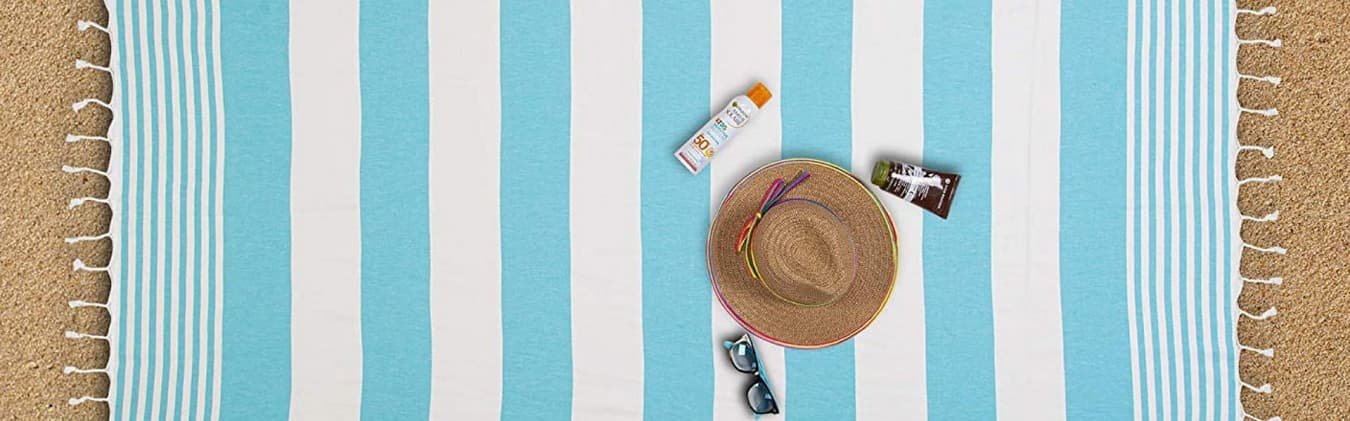
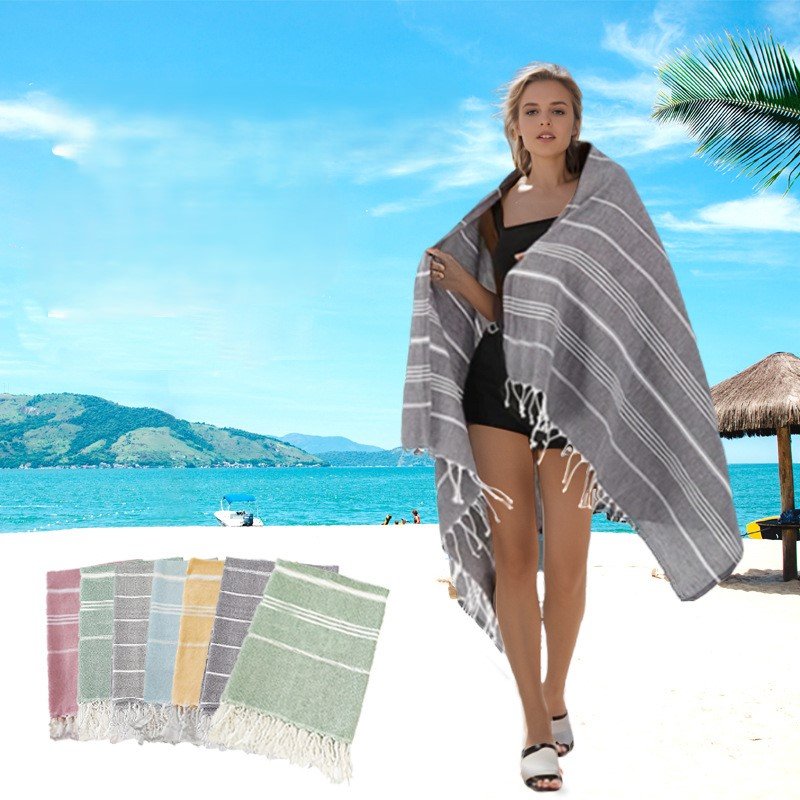
On a beach holiday, size and comfort matter more. A large, lightweight Turkish-style cotton towel can cover a sun lounger or a patch of sand. In addition, many people like the soft cotton feel after a swim. Our Turkish hammam towels follow this flat-woven style.
Best Towel for Everyday Travel and Quick Stops
For city trips, hostels, and gym stops, a towel must dry fast and fold small. Therefore, look for a towel with a clear drying test. A microfiber towel or a thin cotton towel can both work well. Meanwhile, hanging options such as a loop make drying easier.

Turkish Towel vs Microfiber: What Is the Difference?
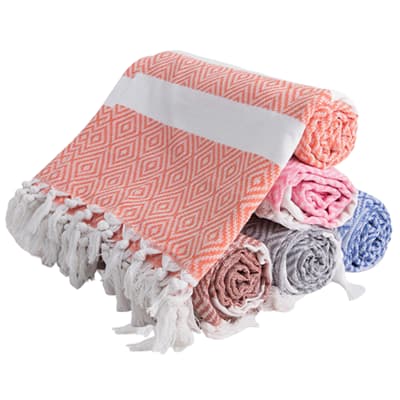
Turkish-style beach towels are usually lightweight cotton towels. They often have a flat-woven or gauzy build. Microfiber travel towels, on the other hand, use very fine man-made fibers. These are often polyester or a polyester–polyamide blend. Still, performance depends on fabric weight, build, and finish, not only on the material name.
For example, REI lists the Slowtide Cheyenne Turkish towel as a double-layered, gauzy, 100% cotton towel. Meanwhile, Sea to Summit sells microfiber towels from the featherweight Airlite to the heavier, terry-like Tek Towel. These are product examples. They do not describe every towel in either group.
What Does “Turkish-Style Cotton” Mean on a Spec Sheet?
Many buyers mix up four different facts. Therefore, we keep them apart:
- Fiber composition: the real cotton, polyester, and polyamide percentages.
- Cotton origin: whether Turkish-grown cotton is documented.
- Towel style: flat-woven hammam, gauze, terry, or another build.
- Manufacturing location: where the finished towel is made.
Watch the wording. “Turkish-style,” “Turkish cotton,” and “Made in Turkey” are three different claims. A Turkish-style towel describes the look and weave. It does not prove the cotton grew in Turkey.
What Is a Hammam (Peshtemal) Towel?
A hammam towel, also called a peshtemal, is a thin, flat-woven towel. Traditionally, people used it in Turkish bathhouses. Today, travelers use it at the beach, at the pool, and in the spa. Because it has no thick loops, it folds small and dries quickly. You can see our range on the Turkish hammam towel page.
Are All Microfiber Beach Towels the Same?
No, they are not. Sea to Summit, for example, shows silky, microsuede, and terry-like finishes. Each one feels different and acts differently. As a result, a smooth ultralight towel and a thick terry-like towel should never be treated as equals.
Which Is Lighter and Packs Smaller?
Some ultralight microfiber towels have a very low carry weight. However, microfiber is not always lighter than every Turkish-style cotton towel. So compare the real size, dry weight, and packed size instead of the fiber name.
| Product Example | Material / Build | Published Size | Published Weight | Published Packed Size |
|---|---|---|---|---|
| Sea to Summit Airlite, Large | Polyester–polyamide microfiber; featherweight | 120 × 60 cm | 67 g (72 g packed) | 8.5 × 6 × 6 cm |
| Sea to Summit Tek Towel, Large | 80% recycled polyester, 20% polyamide; terry-like | 120 × 60 cm | 285 g | 8 × 12 × 20 cm |
| Slowtide Cheyenne Turkish towel (REI listing) | 100% cotton; double-layered, prewashed, gauzy | 73 × 38 inches | 8 ounces | Not provided |
Sources: Sea to Summit and REI product pages. These are brand specs, not Favor test results.
This table teaches three simple lessons. First, two microfiber towels with the same size can differ a lot in weight. Second, a fiber label does not describe the whole towel. Third, the cotton example is much bigger, so a plain weight check is not fair.
Compare Towels at the Same Size
The Slowtide towel is about 185 × 97 cm. That is roughly two and a half times the area of the 120 × 60 cm Airlite. Because of this gap, always compare towels of a similar size first. Otherwise, the numbers can mislead you.
Towel Weight vs Weight With the Pouch
Some brands list the towel alone. Others include the pouch. For instance, the Airlite is 67 g alone and 72 g packed. Therefore, check which number you are reading before you compare two towels.
Why GSM Does Not Tell the Whole Story
GSM means grams per square meter. It shows how dense a fabric is. Still, GSM alone cannot predict drying time, feel, or packed size. A tight, thin weave and a loose, thick weave can share the same GSM. So use GSM together with size, weight, and a real sample.
Which Towel Dries Faster After Swimming?
Lightweight microfiber towels are made for quick drying and small packing. However, there is no universal drying-time winner between microfiber and Turkish-style cotton. Compare specific towels under the same water load, heat, humidity, airflow, and hanging method.
Sea to Summit markets its microfiber towels as quick-drying. REI also markets its Turkish-style cotton example as quick-drying. Neither claim proves a controlled drying-time ratio. For that reason, we avoid claims such as “microfiber dries three times faster” without a documented test.
Drying Your Skin vs Drying the Towel Itself
- Drying your skin: how well the towel removes water while you use it.
- Drying itself: how long the wet towel needs to reach a set dry level.
A towel can be great at the first job and slow at the second. Therefore, judge both separately.
Which Beach Towel Releases Sand More Easily?
Sand release depends on the surface of the towel and on how you use it. Some Turkish-style cotton towels are sold as sand-resistant. For example, REI describes the gauzy Slowtide towel that way. Microfiber, in contrast, ranges from silky to terry-like, so results differ. Therefore, a sand-resistant beach towel claim only fits the specific fabric that was tested.
Dry Sand vs Wet Sand
Dry sand usually shakes off a smooth, flat surface with ease. Wet sand clings to almost every fabric. Because of this, a fair test checks both. We prefer a careful claim such as “releases dry sand easily” over “100% sand-free.” You can browse our beach towel range, including sand-free styles, to see the options.
Which Towel Is More Absorbent and More Comfortable?
Absorbency and comfort are related, but they are not the same. A thin towel may hold a lot of water yet feel rough. A plush towel may feel great yet add bulk. So compare water uptake, skin feel, and use case, and do not expect one material to win every round.
Sea to Summit says its Airlite towel absorbs more than three times its own weight in water. It also calls the heavier Tek Towel the most absorbent towel in its range. Meanwhile, REI calls its Turkish-style cotton example soft and absorbent. However, the brands do not offer a head-to-head test between these products.
Water Uptake vs Skin Feel vs Bulk
- Water uptake per gram: how much water each gram of dry towel can hold.
- Total water capacity: how much the whole towel can hold.
- Skin feel: soft, silky, rough, or plush.
- Thickness and cushioning: useful for lounging on hard ground.
- Weight after use: a wet towel is always heavier in your bag.
Buyer tip: A towel that feels thin in your hand can still dry you well. Judge the towel by how you plan to use it, not by thickness alone.
How to Wash and Store a Travel Beach Towel
Follow the care label of your specific towel. Then dry it fully before you pack it. Do not assume every cotton or microfiber towel can take the same wash heat or tumble drying.
Sea to Summit advises that its Airlite should be fully dry before it goes in a bag. It also states that this towel is not antimicrobial. This is a helpful reminder that “quick-dry” and “antibacterial” are different claims. For more help, read our blog guides on towel care.
- Rinse off salt, sand, and chlorine soon after use.
- Hang the towel in open air until it is fully dry.
- Wash it as the care label says.
- Store it dry, in a loose and airy spot.
Are Turkish Cotton or Recycled Microfiber Towels More Sustainable?
Neither material is the best choice in every case. Instead, ask for the fiber composition, recycled content, sourcing proof, and expected use. Recycled microfiber and cotton are different material paths. Therefore, a fair comparison needs more than a material label.
Some industry numbers add context. Textile Exchange reported about 9.3 million tonnes of recycled polyester in 2024. That was around 12% of all polyester production. In addition, less than 1% of the global fiber market came from recycled textiles. These are global fiber figures. They do not describe beach towels or prove how green one towel is.
What to check on a towel label or spec sheet:
- The recycled polyester share compared with the total towel composition.
- Whether the material comes from bottles or from old textiles.
- The proof available for that exact product.
- Why “recycled” alone does not prove a full environmental benefit.
If you want to see one option, visit our recycled beach towel page. Also, our factory holds OEKO-TEX Standard 100 certification, along with BSCI, SGS, and FDA.
What Should Buyers Check Before Ordering Custom Travel Towels?
Wholesale buyers should compare the finished product spec. That means fiber content, weave, size, GSM, dry weight, packed size, printing sample, wash results, and packaging. A material name alone is not enough to approve a bulk order.
At Favor Houseware, we make recycled microfiber, cotton hammam, cotton velour printed, and microfiber heat-transfer printed towels. Because of this range, we can help you compare real samples side by side. You can also read more about our factory in Yiwu.
Wholesale Procurement Checklist
- Confirm the fiber composition and any origin claims.
- Approve the dimensions and tolerances.
- Record the GSM and finished towel weight.
- Review the artwork on the real fabric.
- Check absorbency and drying performance.
- Review wash results and size change.
- Confirm labels, packaging, MOQ, and lead time against the quote.
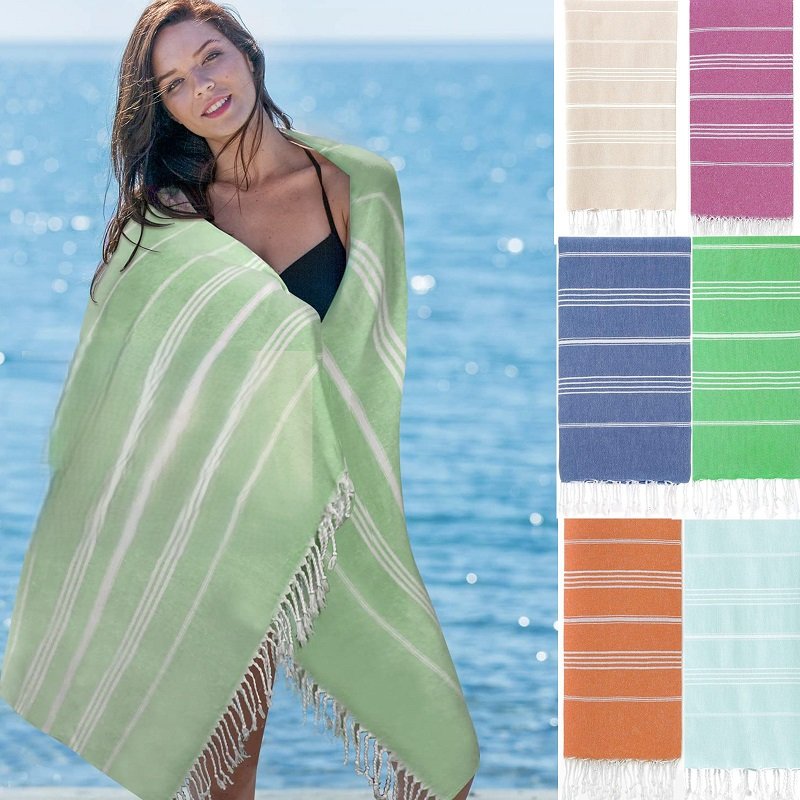

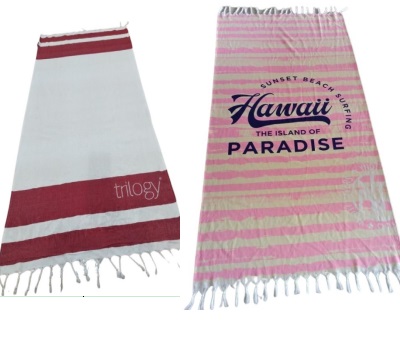
Custom orders are flexible with us. MOQ starts from 100 pieces, and digital printing has no MOQ. Moreover, we offer free samples, and you only pay the freight. Need a changing option as well? See our surf poncho towels.
Turkish Towel vs Microfiber: Frequently Asked Questions
Is a Turkish towel better than microfiber for travel?
Neither is better for everyone. An ultralight microfiber towel can cut packing weight. A large Turkish-style cotton towel offers more beach coverage and a soft cotton feel. So compare the real size, build, weight, and packed size first.
Do microfiber beach towels dry faster than Turkish cotton towels?
Lightweight microfiber towels are made to dry quickly. However, sources do not show a universal drying-time win over every Turkish-style cotton towel. Both groups include towels sold as quick-drying. A fair comparison needs the same test conditions.
Are Turkish towels good for the beach?
Yes. Lightweight Turkish-style cotton towels are sold for beach use. REI, for example, describes the Slowtide Cheyenne as quick-drying, absorbent, and sand-resistant at 73 × 38 inches. Still, those traits belong to that product, not to every Turkish towel.
Are microfiber towels sand-free?
Not by default. Microfiber comes in silky, microsuede, and terry-like finishes. Therefore, any sand-release claim should name the fabric and the test conditions.
Are Turkish towels lighter than microfiber towels?
Not always. Weight depends on size and build. Sea to Summit lists two 120 × 60 cm microfiber towels at 67 g and 285 g. So the fiber type alone does not set the carry weight.
How absorbent are microfiber travel towels?
It varies by product. Sea to Summit says its Airlite absorbs more than three times its own weight in water. That is a brand claim for one towel, not a promise for all microfiber towels.
Does a quick-dry towel prevent odors or bacteria?
No. Quick-dry is not an antimicrobial claim. Sea to Summit states its Airlite is not antimicrobial and should be fully dry before packing. Treat antibacterial claims as a separate feature.
Is recycled microfiber a sustainable towel material?
It can contain recycled polyester. Still, the claim should list the real recycled percentage and proof. Textile Exchange data shows recycled polyester is an established stream. It does not prove that every recycled towel beats every cotton towel.
Final Verdict: Turkish Towel vs Microfiber for Your Travel Plans
In short, the best towel depends on your trip. Choose ultralight microfiber if low weight and a tiny packed size come first. Choose a lightweight Turkish-style cotton towel if you want a big, soft towel for the beach. Above all, check the real size, weight, packed size, and care rules before you decide.
For brands and retailers, the same rule applies. Compare finished samples, not material names. For more buyer guides, visit the Favor Houseware blog.
Compare Turkish-Style Cotton and Microfiber Towel Samples
Share your preferred size, target weight, artwork, and order quantity. Then Favor Houseware can help you pick the right specs. Enjoy free samples (you pay freight only), MOQ from 100 pieces, and no MOQ for digital printing.
Request Free Samples Explore Custom Beach TowelsViews: 0