⚡ Quick Answer — What You Need to Know Right Now
| Question | Short Answer |
|---|---|
| Best material for a luxury beach towel? | Turkish cotton — soft, durable, improves with every wash |
| Best GSM for beach & hotel towels? | 400–550 GSM — comfort + durability sweet spot |
| Turkish cotton vs microfiber — which wins? | Turkish cotton for feel & luxury; microfiber for ultra-light travel only |
| Minimum order quantity (MOQ) for wholesale? | As low as 100 pieces from Favor Houseware |
| Market size of beach towels in 2025? | USD 4.2 billion, growing to USD 8.1 billion by 2036 |
Turkish Cotton Beach Towel: The Complete Guide for Buyers, Brands, and Resorts (2026)
Are you trying to find the best beach towel for your brand, resort, or retail store? Then you are in the right place. This guide covers everything you need to know about Turkish cotton beach towels — from how the fabric works to how to pick a reliable wholesale supplier.
Furthermore, whether you are a hotel buyer, a retail brand, or a first-time importer, this article will help you make a smarter decision. We will also compare Turkish cotton vs microfiber, explain what “luxury beach towel” really means, and share key market trends for 2026.
“A great beach towel is not just a product. It is a brand experience. The right fabric choice makes the difference between a customer who forgets your towel and one who buys it again.”
Let’s start from the beginning.
Part 1: Product & Material Basics
What Is a Turkish Cotton Beach Towel?
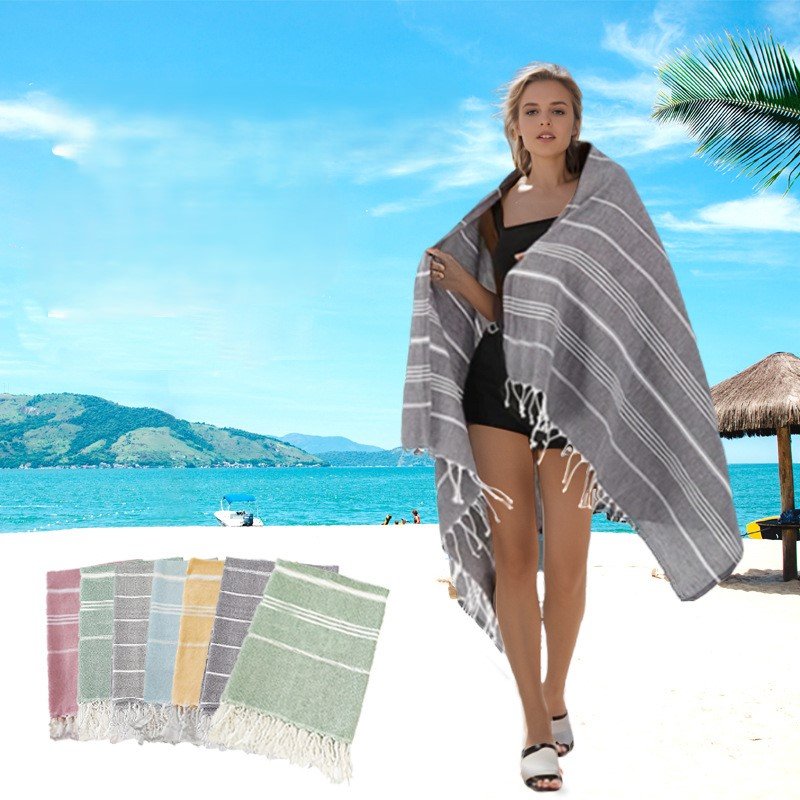
A Turkish cotton beach towel is a towel made from long-staple cotton that originally comes from Turkey’s Aegean region. This type of cotton has longer fibers than regular cotton. And that small difference makes a very big impact on how the towel feels and lasts.
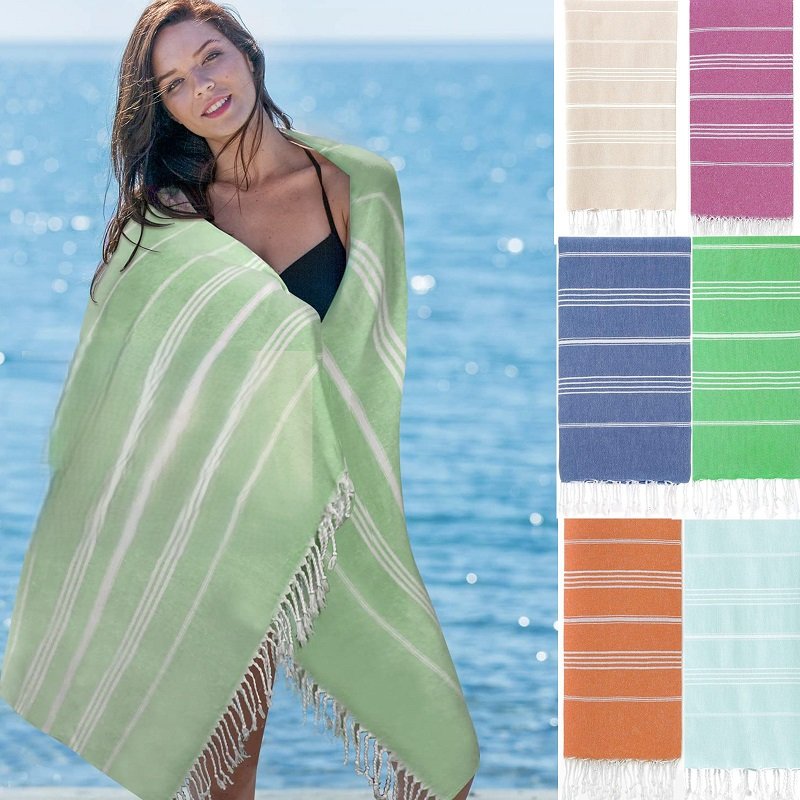
The traditional weaving style used for Turkish towels is called a peshtemal (also written as pestemal or fouta). It is a flat, tight weave — not the loopy pile you see on a regular bath towel. This flat construction is what gives Turkish towels their key beach-friendly advantages.
Key Features of a Turkish Cotton Beach Towel at a Glance
- ✅ Flat peshtemal weave — lightweight and compact
- ✅ Long-staple cotton fibers — fewer joints, softer texture
- ✅ Decorative fringe ends — classic hammam style
- ✅ Sand-resistant — no loops to trap sand
- ✅ Multi-purpose — works as a towel, sarong, blanket, or wrap
- ✅ Available in many sizes and GSM weights for different use cases
Moreover, Turkish towels have been used in Turkish hammam bathhouses for hundreds of years. Therefore, this is not a trendy new product. It is a time-tested textile with a proven track record.
👉 Explore our full range of Turkish hammam towels at Favor Houseware.

Why Turkish Cotton Gets Softer and More Premium Over Time
Here is something that surprises many first-time buyers: Turkish cotton towels actually improve with every single wash. Most products wear out over time. Turkish cotton does the opposite.
Why does this happen? It comes down to the fiber structure. Long-staple cotton fibers gradually open up as they are washed. As a result, the towel becomes softer, fluffier, and more absorbent the more you use it. This is the opposite of synthetic materials, which break down and lose performance over time.
How Turkish Cotton Compares to Regular Cotton Over Time
| Wash Count | Turkish Cotton | Regular Cotton |
|---|---|---|
| First wash | Soft, already improving | Feels fine |
| After 10 washes | Noticeably softer, more absorbent | Starting to pill or stiffen |
| After 50 washes | Peak softness and performance | Noticeably worn |
| After 100+ washes | Still performing well, 5–10 year lifespan | Likely replaced by now |
Additionally, Turkish cotton is naturally odor-resistant. This means it does not develop that musty smell that synthetic towels are known for. For hotel and resort buyers, this is especially important because it keeps towel replacement costs low.
What Makes a Beach Towel “Luxury” or “Hotel Quality”?
The word “luxury” gets used on a lot of beach towels that honestly do not deserve it. So what does it actually mean? And how can you tell the difference between a genuinely premium towel and a cheap one?
Here are the five real factors that define a luxury beach towel or hotel quality towel:
1. GSM (Grams Per Square Metre)
GSM measures how dense and heavy the fabric is. Higher GSM = thicker, more premium feel. For hotel and resort buyers, here is the practical guide:
- 🏖️ 300–400 GSM — Economy beach towel. Lightweight and fast-drying. Good for travel.
- ⭐ 400–500 GSM — Standard luxury. Great balance of comfort and drying speed.
- 🏨 500–600+ GSM — Premium hotel quality. Plush, heavy, and deeply absorbent.
Industry guidance commonly points to 450 GSM as a strong commercial sweet spot for beach and resort towels — heavy enough to feel premium, but light enough to dry quickly between uses.
2. Long-Staple Cotton Construction
Only use towels made from long-staple or combed cotton. Short-staple cotton pills faster and feels rougher. Look for “100% Turkish cotton” or “combed cotton” clearly stated in the product spec.
3. Size and Dimensions
A genuine luxury beach towel should measure at least 37″ × 71″ (94cm × 180cm). Oversized options go up to 40″ × 80″. Undersized towels that barely cover a beach chair are a common quality shortcut to avoid.
4. Weave Quality and Fringe Finishing
Look at the fringe closely. On a quality towel, the fringe is hand-knotted or neatly machine-finished. Raw, unfinished edges that fray after a few washes are a red flag for low-quality production.
5. Colorfastness and Wash Durability
A luxury beach towel should keep its color after many washes and UV exposure. This requires quality reactive dyes and proper finishing. Fading after one season is a clear sign of inferior production.
Turkish Cotton vs Microfiber Beach Towel — Full Comparison
This is the comparison that most buyers search for. So let’s be completely honest about both sides. Below is a detailed, side-by-side breakdown of Turkish cotton beach towels vs microfiber beach towels.
| Feature | Turkish Cotton Beach Towel | Microfiber Beach Towel |
|---|---|---|
| Feel on skin | Soft, natural, premium — gets better with use | Smooth but synthetic — can feel clammy when wet |
| Drying speed | Fast (~60 min) — competitive for most beach use | Fastest (~20–30 min) — wins for ultra-quick dry |
| Luxury appeal | Strong — ideal for hotels, resorts, premium retail | Functional — perceived as budget or sports product |
| Sand performance | Excellent — flat weave shakes clean easily | Good — but can attract and hold fine sand |
| Odor resistance | High — naturally odor-resistant cotton | Low — synthetic fibers trap bacteria and odors |
| Eco-friendliness | Strong — natural, biodegradable fiber | Weak — sheds microplastics with every wash |
| Durability | 5–10 years — improves over time | 2–4 years — degrades with repeated washing |
| Packability | Good — packs much smaller than terry cloth | Best — compresses to fist-size |
| Sustainability story | Strong — natural fiber narrative for eco buyers | Weak — synthetic material is a harder eco sell |
| Best for | Resorts, luxury retail, hotel amenities, gifting | Ultralight travel, sports, quick-use cases |
In addition to the table above, it is also worth noting the environmental angle. According to research from Textile World, synthetic microfibers are now one of the most commonly detected pollutants in marine environments. As a result, eco-conscious brands and hospitality buyers are increasingly moving toward natural-fiber options like Turkish cotton.
👉 Need a microfiber option too? Browse our microfiber towel collection for fast-drying travel and sports use cases.
Is Microfiber Better for Fast Drying, or Is Turkish Cotton Better for Overall Use?
This is the real question. And the honest answer is: it depends on your priority.
Microfiber is technically faster at drying — typically 20 to 30 minutes versus about 60 minutes for Turkish cotton. However, for most beach and resort scenarios, that gap simply does not matter. Both towels will be completely dry before your next swim.
On the other hand, Turkish cotton wins on almost every other measure — feel, luxury perception, odor resistance, eco-friendliness, and long-term durability. Therefore, for any brand or business that cares about product quality and customer experience, Turkish cotton is the smarter overall choice.
Choose Turkish cotton if comfort, luxury, and brand value matter most.
Choose microfiber only if ultralight packing and the fastest possible dry time are the top priorities.
Part 2: Buying & Performance Guide
Which Towel Dries Faster: Turkish Cotton or Microfiber?
Let’s answer this directly, because it is one of the most searched questions about beach towels.
- 🕐 Microfiber towel dry time: approximately 20–30 minutes
- 🕐 Turkish cotton towel dry time: approximately 45–60 minutes
- 🕐 Regular terry cloth towel dry time: 2–4 hours
So yes — microfiber dries faster. But here is the context that most articles leave out. A Turkish cotton peshtemal dries dramatically faster than a regular terry cloth bath towel. Furthermore, the 30-minute gap between Turkish cotton and microfiber only matters in very specific situations — like back-to-back water activities with no break in between.
For hotel laundry cycles, beach club operations, and everyday consumer use, both dry well within a normal turnaround window. Therefore, drying speed alone is rarely a good enough reason to choose microfiber over Turkish cotton for premium applications.
Which Towel Feels More Comfortable on Skin and Sand?
When it comes to comfort, Turkish cotton beach towels win clearly. Here is why:
The long-staple cotton fibers create a smooth, naturally soft surface. This feels gentle on sun-sensitized skin. In contrast, microfiber against wet skin can feel squeaky or slightly scratchy — especially in humid beach conditions.
Additionally, as we covered earlier, Turkish cotton gets softer with every wash. So the towel you buy today will feel even better six months from now.
For sand performance, both materials perform well — but for different reasons. Microfiber’s synthetic surface gives sand little to grip. Turkish cotton’s flat weave does the same thing without any loops for sand to get trapped in. One good shake and both are clean. Practically speaking, this is a tie.
Which Material Is Better for Beach, Pool, Travel, and Resort Use?
Different use cases call for different towel choices. Here is a simple guide to help you match the right material to the right situation:
| Use Case | Best Choice | Why |
|---|---|---|
| 🏖️ Beach day | Turkish cotton | Sand-free, comfortable, stylish |
| 🏊 Pool lounge | Turkish cotton (high GSM) | Plush feel, durable for daily laundering |
| ✈️ Travel / carry-on | Microfiber or light Turkish cotton | Compact, lightweight packing |
| 🏨 Hotel amenity | Turkish cotton (400–600 GSM) | Premium feel, long lifespan, wash durability |
| 🎁 Gift or branded product | Turkish cotton | Premium perception, high perceived value |
| 🏄 Surf & water sports | Changing poncho or robe | Full coverage for changing outdoors |
Speaking of surf and water sports — we also offer surf poncho towels and surf changing robes for brands in the action sports market.
What GSM Is Best for Beach Towels and Hotel Towels?
GSM stands for grams per square metre. It is the single most important specification to understand when buying towels in bulk. Here is a clear breakdown:
GSM Guide for Beach & Hotel Towel Buyers
- 300–400 GSM — Lightweight, travel-friendly, fast-drying. Best for promotional giveaways and budget retail.
- 400–500 GSM — Standard luxury range. Best for premium retail, beach clubs, and mid-range hotels.
- 500–600 GSM — Plush and heavy. Best for 4-star and 5-star hotel amenities and spa use.
- 600+ GSM — Ultra-premium. Very plush but slower to dry. Best for high-end spa and boutique hotel collections.
🎯 Recommended sweet spot for most buyers: 450 GSM. It balances comfort, absorbency, drying speed, and cost — making it the most commercially versatile choice.
Furthermore, GSM also affects your shipping costs. Heavier towels cost more to ship per unit. Therefore, for large wholesale orders, balancing GSM against logistics costs is an important part of your sourcing decision.
How to Choose the Right Beach Towel for Retail or Hospitality Buyers
Choosing the right towel for your specific channel is different from choosing one for personal use. Here are the most important factors for retail and hospitality buyers to consider:
- Define your end-use: Hotel pool towel? Branded retail product? Corporate gift? Each has a different ideal GSM and size.
- Set your GSM target: Use the guide above to match fabric weight to your use case and price point.
- Decide on customization needs: Do you need custom colors, woven logos, or printed patterns? Make sure your supplier can deliver.
- Check certifications: For export and retail, look for OEKO-TEX 100, BSCI, and SGS certifications to ensure compliance.
- Request samples first: Never place a bulk order without testing samples for feel, color accuracy, and wash durability.
- Clarify MOQ and lead time: Make sure minimum order quantities and production timelines fit your business model.
Additionally, for eco-focused brands, consider exploring our recycled beach towel options — made from sustainable materials and ideal for environmentally-conscious retail positioning.
Part 3: B2B & Wholesale Buyer Guide
What to Look for in a Beach Towel Manufacturer
Finding a good beach towel manufacturer is not just about finding the lowest price. Instead, it is about finding a partner who can deliver consistent quality at scale. Here is what to look for:
Non-Negotiable Manufacturer Checklist
- ✅ Fabric consistency — GSM accuracy should be within ±5% of stated spec
- ✅ Wash durability testing — color retention and shrinkage control after 30+ washes
- ✅ Certifications — OEKO-TEX 100, BSCI, SGS, FDA as applicable
- ✅ Production capacity — can they scale with your order growth?
- ✅ Customization capability — woven labels, printed patterns, custom sizing
- ✅ Quality control process — inspection at raw material, production, and pre-shipment stages
- ✅ Export experience — familiarity with your target market’s compliance requirements
- ✅ Sample policy — do they offer samples before bulk orders?
At Favor Houseware, we carry BSCI, OEKO-TEX 100, SGS, and FDA certifications. Moreover, we offer free samples — you only pay freight. This means you can verify quality before committing to any order.
How to Evaluate a Reliable Beach Towel Supplier
Once you have a shortlist of manufacturers, how do you evaluate which one to trust? Here is a practical framework:
Step-by-Step Supplier Evaluation Process
- Request a company profile — years in business, production capacity, main export markets
- Ask for certifications — verify OEKO-TEX and BSCI certificates are current
- Order samples — test feel, weight, color accuracy, and post-wash performance
- Check references — ask for buyer testimonials or case studies from similar industries
- Clarify payment and trade terms — T/T, L/C, and escrow options signal a professional supplier
- Evaluate communication — response time and clarity are early signals of how a supplier will perform under pressure
- Visit or audit the factory — or request a virtual factory tour if an in-person visit is not possible
“The best time to evaluate a supplier is before you need them in a rush. Vet carefully before you place your first order — and the whole relationship becomes much smoother.”
OEM and ODM Options for Custom Beach Towels
For brands that want to create their own product line, understanding OEM vs ODM is essential.
- OEM (Original Equipment Manufacturing): You provide the design spec. The manufacturer produces exactly what you specify. Best for brands with a clear product vision.
- ODM (Original Design Manufacturing): The manufacturer provides existing designs that you can customize and brand. Best for new brands or buyers who want a faster path to market.
At Favor Houseware, we support both OEM and ODM orders. Furthermore, we offer digital printing with no minimum order quantity — which is a significant advantage for small brands and test orders. In addition, our customization options include:
- Custom sizes from standard to oversized (up to 40″ × 80″)
- Custom GSM weights from 300 to 600+
- Custom colors and stripe patterns via reactive dyeing
- Woven jacquard logos and brand labels
- Custom fringe styles: twisted, knotted, or hemmed
- Private label packaging for retail-ready presentation
👉 Learn more about our capabilities on the About Favor Houseware page.
Best Fabric, Size, Weight, and Packaging for Wholesale Orders
When placing a wholesale order, the four most important product specifications to lock down are fabric, size, weight, and packaging. Here is a practical guide for each:
🧵 Fabric
100% Turkish cotton or combed cotton for premium positioning. Consider recycled cotton for eco-focused retail.
📐 Size
Standard: 37″×71″. Oversized: 40″×80″. Round towels also available. Confirm dimensions match your market’s preferences.
⚖️ Weight (GSM)
400–550 GSM for most commercial orders. Higher GSM for hotel; lighter GSM for travel and promotional use.
📦 Packaging
OPP bag, rolled and banded, gift box, or retail hang-tag packaging. Match packaging to your channel (retail shelf vs. hotel amenity).
How Chinese Beach Towel Manufacturers Support Private Label Buyers
China is the world’s largest exporter of textile products, and Chinese manufacturers have developed deep expertise in supporting private label and wholesale buyers from start to finish. Here is what a good Chinese beach towel manufacturer should provide:
- End-to-end manufacturing — weaving, dyeing, printing, cutting, sewing, inspection, and shipping under one roof
- Low MOQ flexibility — supporting small orders (100 pieces) as well as large bulk production
- Private label branding — custom hang tags, woven labels, packaging inserts, and branded poly bags
- Export documentation support — commercial invoices, packing lists, certificates of origin
- Quality inspection before shipment — third-party inspection available on request
- Fast delivery options — both air freight and sea freight, with in-stock items available for quick dispatch
Favor Houseware’s factory is located in Yiwu, Jinhua, Zhejiang Province — one of China’s most efficient manufacturing and export hubs. As a result, we offer competitive lead times and reliable logistics access to all major global markets.
👉 Ready to start? Contact our team for samples and a custom quotation.
Part 4: Market Trends & Commercial Context
Beach Towel Market Trends: What Buyers Are Looking for in 2026
The beach towel market is growing fast. And understanding what is driving that growth helps buyers and brands make smarter product decisions. Here are the key trends shaping the market in 2026:
📊 Beach Towel Market at a Glance (2025–2036)
- Global market value in 2025: USD 4.2 billion
- Projected value by 2036: USD 8.1 billion
- Forecast CAGR (2026–2036): 6.2%
- Cotton towels share: 38% of market by material
- Peak search and sales demand: July–August annually
Note: Market data from multiple industry reports used as directional estimates. Figures may vary by report methodology and scope.
Top 5 Trends Driving Beach Towel Demand in 2026
- Eco-friendly materials: Buyers are actively seeking organic cotton, recycled fibers, and sustainable production certifications. Brands that can tell a clear sustainability story have a competitive edge.
- Premium and luxury positioning: As travel recovers globally, demand for hotel-quality and resort-grade towels is growing. Luxury Turkish towel demand is projected to grow 15–20% annually through 2026.
- Bold, on-trend designs: Tropical prints, geometric patterns, and retro motifs dominated collections in 2025. Custom-designed towels are increasingly part of brand identity strategies.
- Hybrid and functional fabrics: Cotton-microfiber blends and antibacterial treatments are gaining traction for performance-focused buyers.
- Private label growth: More retail brands and hospitality groups are moving away from generic suppliers toward custom-branded towel programs with defined quality specs.
Why Cotton Towels Still Dominate the Premium Segment
Despite the rise of microfiber and synthetic alternatives, cotton towels continue to dominate the premium end of the market. Cotton holds a 38% material share across beach towel categories — and that share is even higher in the luxury and hotel segment.
Why does cotton keep winning at the premium level? Several reasons:
- Natural fiber story: Eco-conscious consumers and brands increasingly prefer natural materials over synthetics.
- Feel and comfort: No synthetic material has matched the natural softness and breathability of long-staple cotton against skin.
- Brand perception: Cotton — especially Turkish cotton — carries a premium narrative that synthetic materials simply cannot match.
- Sustainability credentials: As microplastic concerns grow, cotton’s biodegradable nature is becoming a genuine competitive advantage.
For more insight into textile industry trends, the team at Textile World publishes excellent ongoing coverage of global fabric and towel market developments.
Why Hotels and Resorts Prefer Durable, High-GSM Towels
Hotels and resorts wash towels hundreds of times per year. Therefore, durability is not a nice-to-have — it is a financial necessity. Here is what drives hotel towel buying decisions:
- 🏨 Wash durability: A towel that holds its weight, color, and softness after 200+ industrial washes lowers replacement costs significantly.
- 🏨 Guest experience: A plush, high-GSM Turkish cotton towel creates a tangible impression of quality that cheaper towels cannot replicate.
- 🏨 Brand consistency: Custom-branded towels with woven logos reinforce the hotel’s identity at every guest touchpoint.
- 🏨 Bulk economics: High-GSM towels cost more per unit but cost less per use when amortized over their longer lifespan.
For hotel and resort buyers, the recommended specification is 500–600 GSM Turkish cotton, with reactive dyeing for color durability and reinforced selvedge edges for wash resistance.
Common Mistakes When Sourcing Beach Towels Wholesale
Even experienced buyers make sourcing mistakes. Here are the most common ones — and how to avoid them:
- Ordering without samples. Never skip the sample stage. A product that looks good in a catalog or photo can feel very different in person. Always test before you commit.
- Choosing by price alone. The cheapest quote often means lower GSM, shorter staple cotton, or weaker dyeing. Total cost of ownership matters more than unit price.
- Ignoring certifications. For retail markets in the US, EU, and Australia, product safety and sustainability certifications are increasingly required. OEKO-TEX 100 is a minimum for most premium retail channels.
- Underestimating lead times. Quality custom production takes time. Plan for 30–60 day production lead times on OEM orders, especially during peak season (Q2–Q3).
- Not locking in GSM and size specs in writing. Verbal agreements on specs lead to disputes. Always confirm GSM, dimensions, and tolerances in a written purchase order.
- Overlooking packaging requirements. If your towels are going to retail shelves, packaging matters just as much as the product. Confirm hang-tag specs, poly bag dimensions, and barcode requirements with your supplier upfront.
Part 5: Frequently Asked Questions About Turkish Cotton, Microfiber, and Wholesale Beach Towels
Below are answers to the most common questions buyers, brands, and consumers ask about Turkish cotton beach towels, microfiber, and wholesale sourcing.
What is the best material for a beach towel?
For most uses, Turkish cotton is the best material for a beach towel. It combines absorbency, comfort, quick-drying performance, and a luxury feel that improves over time. For ultra-lightweight travel where pack size is the top priority, microfiber is a practical alternative.
Is Turkish cotton better than microfiber?
For comfort, luxury, and long-term value — yes, Turkish cotton is better than microfiber in most scenarios. Microfiber dries faster, but Turkish cotton wins on feel, odor resistance, durability, and eco-friendliness. For hotel, resort, and premium retail use, Turkish cotton is the clear choice.
Are Turkish towels good for the beach?
Yes — Turkish towels are excellent for the beach. They are lightweight, compact, naturally sand-resistant due to their flat weave, quick-drying compared to regular terry cloth, and versatile enough to use as a wrap, blanket, or sarong. They are purpose-built for beach and travel use.
What GSM is best for a beach towel?
A practical GSM range for beach and hotel towels is 400–550 GSM. Lighter towels (300–400 GSM) dry faster and pack smaller. Heavier towels (500–600+ GSM) feel more plush and luxurious. For most commercial buyers, 450 GSM is the recommended sweet spot — it balances comfort, absorbency, drying speed, and cost.
What is a hotel quality towel?
A hotel quality towel typically means a towel that is highly absorbent, durable through industrial laundering, and plush enough to create a positive guest experience. In terms of specs, premium hotel towels are commonly 500–600 GSM, made from long-staple cotton, with reactive dyes for color durability. Certifications like OEKO-TEX 100 are also standard for reputable hotel procurement.
How do I choose a beach towel manufacturer?
Look for these key factors: fabric consistency, GSM accuracy, wash durability, customization capability, MOQ flexibility, quality certifications, and export experience. For wholesale buyers, the ability to support OEM/ODM orders, provide private label packaging, and offer responsive communication matters just as much as the towel itself. Request samples before placing any bulk order.
What is the difference between Turkish cotton and regular cotton?
The main difference is fiber length. Turkish cotton uses long-staple fibers, which are longer and smoother than regular cotton. This results in a softer texture, fewer joints per yarn (which reduces pilling), greater absorbency, and a towel that improves with washing rather than degrading over time.
Are microfiber towels better for travel?
Microfiber towels have one clear advantage for travel: they compress to an extremely small size and dry in 20–30 minutes. If packing weight is your primary concern, microfiber is a practical choice. However, for travelers who want comfort and a premium feel, a lightweight Turkish cotton peshtemal (300–350 GSM) is a great travel-friendly alternative that still packs much smaller than a regular bath towel.
👉 Browse our microfiber towel range for travel-focused options.
Why are Turkish towels so expensive?
Turkish towels cost more because of the quality of the raw material and the weaving process. Long-staple Aegean cotton is more expensive to source than regular cotton. The peshtemal flat-weave construction requires more precise production control. Additionally, the durability and lifespan of Turkish cotton means you are paying for a towel that will last 5–10 years — making the cost-per-use much lower than cheaper alternatives.
What should I ask a beach towel supplier?
Here are the most important questions to ask any beach towel supplier before placing an order:
- What certifications do you hold? (OEKO-TEX, BSCI, SGS)
- What is your GSM tolerance on production runs?
- Can you share wash durability test results?
- What is your minimum order quantity (MOQ) for custom orders?
- Do you offer samples before bulk production?
- What are your lead times for OEM/ODM orders?
- What packaging options do you offer?
- How do you handle quality control before shipment?
Conclusion: Your Next Step Toward a Better Beach Towel Program
By now, you have a complete picture. Turkish cotton beach towels are genuinely the best all-round choice for comfort, luxury, durability, and brand positioning. They beat microfiber on every measure that matters for premium applications — feel, longevity, eco-friendliness, and perceived value.
Meanwhile, the global beach towel market is growing fast — from USD 4.2 billion in 2025 toward USD 8.1 billion by 2036. The brands and buyers who invest in quality now will be the ones who build lasting customer loyalty.
Whether you are sourcing for a hotel group, a retail brand, a beach club, or a corporate gifting program, the right towel partner makes all the difference. Favor Houseware brings 15 years of manufacturing experience, full OEM/ODM capability, low MOQ starting at 100 pieces, and certifications including BSCI, OEKO-TEX 100, SGS, and FDA.
Ready to Source Premium Turkish Cotton Beach Towels?
Get free samples, custom quotes, and expert guidance from Favor Houseware — a trusted China beach towel manufacturer with 15 years of experience serving global brands, hotels, and retailers.
Favor Houseware Co., Ltd. | Yiwu, Zhejiang, China | favor-houseware.com | MOQ from 100 pcs | Free samples available
Views: 0